


Page 34 - (DK Eyewitness) Travel Guide - London
P. 34
32 INTRODUCING L ONDON
London and Two World Wars
During World War I, Zeppelin airships bombed the city, and the sight
of injured soldiers returning from the front to be treated at Charing
Cross Hospital became familiar. The society that emerged from the
war embraced the innovations of the early 20th century – the motor
car, telephone and commuter transport. Then came the Depression
of the 1930s, the effects of which had barely worn off when World
War II began. The city was once again bombarded, though on a Extent of the City
vastly bigger scale, most notably during the Blitz of 1940–41. 1938 Today
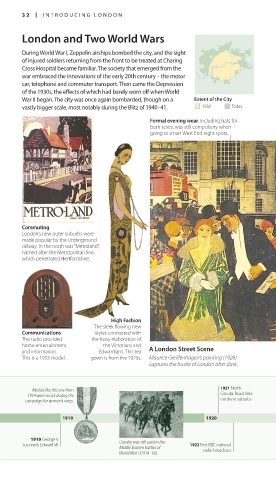
Formal evening wear, including hats for
both sexes, was still compulsory when
going to smart West End night spots.
Commuting
London’s new outer suburbs were
made popular by the Underground
railway. In the north was “Metroland”,
named after the Metropolitan line,
which penetrated Hertfordshire.
High Fashion
The sleek flowing new
Communications styles contrasted with
The radio provided the fussy elaboration of
home entertainment the Victorians and A London Street Scene
and information. Edwardians. This tea
This is a 1933 model. gown is from the 1920s. Maurice Greiflenhagen’s painting (1926)
captures the bustle of London after dark.
Medals like this one from 1921 North
1914 were struck during the Circular Road links
campaign for women’s votes. northern suburbs
1910 1920 1925
1910 George V Cavalry was still used in the
succeeds Edward VII 1922 First BBC national
Middle Eastern battles of
World War I (1914–18). radio broadcast
032-033_EW_London.indd 32 21/03/17 2:19 pm

