


Page 159 - Inventions - A Visual Encyclopedia (DK - Smithsonian)
P. 159
SEEING IN COLOR
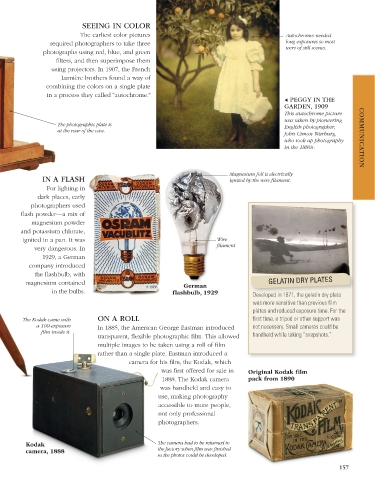
                           The earliest color pictures                                        Autochromes needed
                 required photographers to take three                                         long exposures so most
                                                                                              were of still scenes.
               photographs using red, blue, and green
                   filters, and then superimpose them
                  using projectors. In 1907, the French
                     Lumière brothers found a way of
                combining the colors on a single plate
                in a process they called “autochrome.”
                                                                                              ◀ PEGGY IN THE
                                                                                              GARDEN, 1909
                                                                                              This autochrome picture
                                                                                              was taken by pioneering
                    The photographic plate is                                                 English photographer,
                    at the rear of the case.
                                                                                              John Cimon Warburg,
                                                                                              who took up photography   COMMUNICATION
                                                                                              in the 1880s.


                                                                            Magnesium foil is electrically
               IN A FLASH                                                   ignited by the wire filament.
                For lighting in
             dark places, early
           photographers used
        flash powder—a mix of
           magnesium powder
        and potassium chlorate,
        ignited in a pan. It was                                        Wire
            very dangerous. In                                          filament
               1929, a German
          company introduced
            the flashbulb, with
         magnesium contained                                 German                      GELATIN DRY PLATES
                  in the bulbs.                          flashbulb, 1929            Developed in 1871, the gelatin dry plate
                                                                                    was more sensitive than previous film
                                                                                    plates and reduced exposure time. For the
        The Kodak came with      ON A ROLL                                          first time, a tripod or other support was
             a 100-exposure      In 1885, the American George Eastman introduced    not necessary. Small cameras could be
              film inside it.
                                 transparent, flexible photographic film. This allowed   handheld while taking “snapshots.”
                                 multiple images to be taken using a roll of film
                                 rather than a single plate. Eastman introduced a
                                           camera for his film, the Kodak, which
                                                      was first offered for sale in   Original Kodak film
                                                      1888. The Kodak camera      pack from 1890
                                                     was handheld and easy to
                                                     use, making photography
                                                     accessible to more people,
                                                     not only professional
                                                     photographers.


         Kodak                                       The camera had to be returned to
         camera, 1888                                the factory when film was finished
                                                     so the photos could be developed.
                                                                                                                157


   US_156-157_308121_Camera.indd   157                                                                           08/03/2018   17:17

