


Page 162 - Inventions - A Visual Encyclopedia (DK - Smithsonian)
P. 162
Cinema


          In 1891, the American Edison company demonstrated

          its Kinetoscope—a camera designed for “moving
                                                                                   GLORIOUS TECHNICOLOR            ®
          pictures” to be watched by one person at a time                                Early attempts at color involved

          through a viewer window. Four years later, films were                       hand-tinting the film. Beginning in
                                                                                         1932, the Technicolor company
          shown to audiences of hundreds, but it wasn’t until
      COMMUNICATION  1927 that The Jazz Singer became the first film made           standard process until the mid-1950s.
                                                                                   introduced a camera, below, that used
                                                                                       three separate films to record red,
                                                                                       blue, and green. This became the
          with recorded sound.


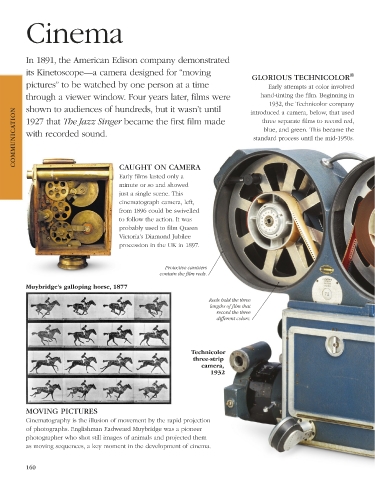
                                        CAUGHT ON CAMERA
                                        Early films lasted only a
                                        minute or so and showed
                                        just a single scene. This
                                        cinematograph camera, left,
                                        from 1896 could be swivelled
                                        to follow the action. It was
                                        probably used to film Queen
                                        Victoria’s Diamond Jubilee
                                        procession in the UK in 1897.


                                                       Protective canisters
                                                     contain the film reels.

          Muybridge’s galloping horse, 1877
                                                                     Reels hold the three
                                                                      lengths of film that
                                                                        record the three
                                                                        different colors.


                                                                Technicolor
                                                                three-strip
                                                                   camera,
                                                                      1932


          MOVING PICTURES
          Cinematography is the illusion of movement by the rapid projection
          of photographs. Englishman Eadweard Muybridge was a pioneer
          photographer who shot still images of animals and projected them
          as moving sequences, a key moment in the development of cinema.


          160


   US_160-161_308121_Cinema.indd   160                                                                           09/03/2018   15:25

