


Page 229 - Inventions - A Visual Encyclopedia (DK - Smithsonian)
P. 229
Marie Curie                                                               84 Po     which polonium and
                                                                                             Uranium ore, from
                                                                                     (209)
                                                                                            radium are extracted
                                                                                  POLONIUM

        One of the great scientists of her age, the Polish-French                 88  (226)
        physicist Marie Curie was a pioneer in the study                          Ra
                                                                                   RADIUM
        of radioactivity—the stream of energetic particles
        produced when unstable atoms break up. Her work                                       NEW ELEMENTS
                                                                                When Curie arrived in Paris, scientists
        improved our understanding of radioactivity, leading                      had recently discovered that certain
        to the treatment of cancers with radiation. For her                         elements, such as uranium, were
                                                                                radioactive. Working with her husband,
        discoveries of two radioactive elements, she became                      the scientist Pierre Curie, and alone,    IN GOOD HEALTH
        the first person to be awarded two Nobel Prizes.                         she discovered two more radioactive
                                                                              elements, polonium and radium, in 1898.

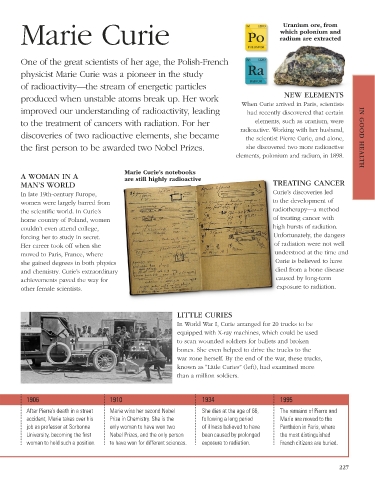
                                          Marie Curie’s notebooks
        A WOMAN IN A                      are still highly radioactive
        MAN’S WORLD                                                                       TREATING CANCER
        In late 19th-century Europe,                                                      Curie’s discoveries led
        women were largely barred from                                                    to the development of
        the scientific world. In Curie’s                                                  radiotherapy—a method
        home country of Poland, women                                                     of treating cancer with
        couldn’t even attend college,                                                     high bursts of radiation.
        forcing her to study in secret.                                                   Unfortunately, the dangers
        Her career took off when she                                                       of radiation were not well
        moved to Paris, France, where                                                      understood at the time and
        she gained degrees in both physics                                                 Curie is believed to have
        and chemistry. Curie’s extraordinary                                               died from a bone disease
        achievements paved the way for                                                     caused by long-term
        other female scientists.                                                           exposure to radiation.


                                                           LITTLE CURIES
                                                           In World War I, Curie arranged for 20 trucks to be
                                                           equipped with X-ray machines, which could be used
                                                           to scan wounded soldiers for bullets and broken
                                                           bones. She even helped to drive the trucks to the
                                                           war zone herself. By the end of the war, these trucks,
                                                           known as “Little Curies” (left), had examined more
                                                           than a million soldiers.


          1906                       1910                          1934                     1995

          After Pierre’s death in a street   Marie wins her second Nobel    She dies at the age of 66,   The remains of Pierre and
          accident, Marie takes over his    Prize in Chemistry. She is the    following a long period    Marie are moved to the
          job as professor at Sorbonne   only woman to have won two   of illness believed to have   Panthéon in Paris, where
          University, becoming the first   Nobel Prizes, and the only person    been caused by prolonged   the most distinguished
          woman to hold such a position.  to have won for different sciences.  exposure to radiation.  French citizens are buried.


                                                                                                                227


   US_226-227_Marie_Curie_Inventor.indd   227                                                                    08/03/18   6:39 PM

