


Page 230 - Inventions - A Visual Encyclopedia (DK - Smithsonian)
P. 230
Better diagnoses


          Until around 200 years ago, the only tools doctors had
                                                                                              FAST FACTS
          for identifying illnesses were their own expertise and

          the patients’ descriptions of their symptoms. Since then,                 ■ ■ The ancient Greeks first came up with
                                                                                    the term “diagnosis,” meaning to identify
          a wide array of instruments for testing patients’ health                  an illness. They believed illnesses were
                                                                                    caused by an excess or lack of four body
          and working out what their symptoms mean has been
      IN GOOD HEALTH  developed. This has helped to turn diagnosis from a           black bile, and phlegm.
                                                                                    fluids called humors: blood, yellow bile,
                                                                                     ■ In the 19th century, some scientists
          guessing game into something more scientific.
                                                                                    ■
                                                                                    believed that someone’s mental health
                                                                                    could be diagnosed by phrenology—
                                                                                    the study of the shape and size of a
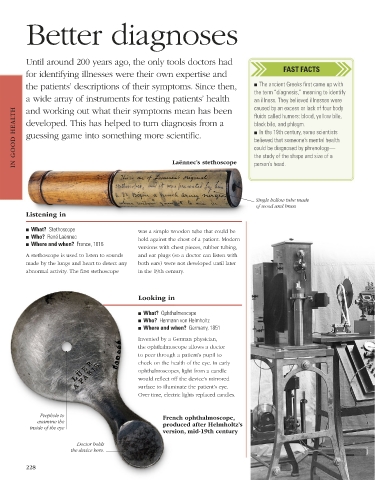
                                                         Laënnec’s stethoscope
                                                                                    person’s head.


                                                                                     Single hollow tube made
                                                                                     of wood and brass
          Listening in

          ■ ■ What?  Stethoscope              was a simple wooden tube that could be
          ■ ■ Who?  René Laënnec              held against the chest of a patient. Modern
          ■ ■ Where and when?  France, 1816
                                              versions with chest pieces, rubber tubing,
          A stethoscope is used to listen to sounds   and ear plugs (so a doctor can listen with
          made by the lungs and heart to detect any   both ears) were not developed until later
          abnormal activity. The first stethoscope    in the 19th century.


                                              Looking in


                                              ■ ■ What?  Ophthalmoscope
                                              ■ ■ Who?  Hermann von Helmholtz
                                              ■ ■ Where and when?  Germany, 1851
                                              Invented by a German physician,
                                              the ophthalmoscope allows a doctor
                                              to peer through a patient’s pupil to
                                              check on the health of the eye. In early
                                              ophthalmoscopes, light from a candle
                                              would reflect off the device’s mirrored
                                              surface to illuminate the patient’s eye.
                                              Over time, electric lights replaced candles.


              Peephole to                             French ophthalmoscope,
             examine the                              produced after Helmholtz’s
           inside of the eye
                                                      version, mid-19th century

                          Doctor holds
                        the device here.

          228


   US_228-229_Better_diagnoses_Gallery.indd   228                                                                08/03/18   3:10 PM

