


Page 231 - Inventions - A Visual Encyclopedia (DK - Smithsonian)
P. 231
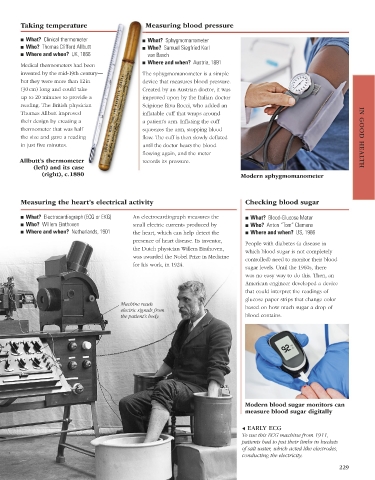
Taking temperature                       Measuring blood pressure


        ■ ■ What?  Clinical thermometer         ■ ■ What?  Sphygmomanometer
        ■ ■ Who?  Thomas Clifford Allbutt       ■ ■ Who?  Samuel Siegfried Karl
        ■ ■ Where and when?  UK, 1866             von Basch
        Medical thermometers had been           ■ ■ Where and when?  Austria, 1881
        invented by the mid-19th century—       The sphygmomanometer is a simple
        but they were more than 12 in           device that measures blood pressure.
        (30 cm) long and could take             Created by an Austrian doctor, it was
        up to 20 minutes to provide a           improved upon by the Italian doctor
        reading. The British physician          Scipione Riva Rocci, who added an
        Thomas Allbutt improved                 inflatable cuff that wraps around
        their design by creating a              a patient’s arm. Inflating the cuff
        thermometer that was half               squeezes the arm, stopping blood
        the size and gave a reading             flow. The cuff is then slowly deflated                                 IN GOOD HEALTH
        in just five minutes.                   until the doctor hears the blood
                                                flowing again, and the meter
       Allbutt’s thermometer                    records its pressure.
            (left) and its case
               (right), c. 1880                                                 Modern sphygmomanometer


        Measuring the heart’s electrical activity                                Checking blood sugar


        ■ ■ What?  Electrocardiograph (ECG or EKG)  An electrocardiograph measures the    ■ ■ What?  Blood-Glucose Meter
        ■ ■ Who?  Willem Einthoven          small electric currents produced by    ■ ■ Who?  Anton “Tom” Clemens
        ■ ■ Where and when?  Netherlands, 1901  the heart, which can help detect the   ■ ■ Where and when?  US, 1966
                                            presence of heart disease. Its inventor,    People with diabetes (a disease in
                                            the Dutch physician Willem Einthoven,    which blood sugar is not completely
                                            was awarded the Nobel Prize in Medicine    controlled) need to monitor their blood
                                            for his work, in 1924.
                                                                                 sugar levels. Until the 1960s, there
                                                                                 was no easy way to do this. Then, an
                                                                                 American engineer developed a device
                                                                                 that could interpret the readings of
                                                                                 glucose paper strips that change color
                                        Machine reads                            based on how much sugar a drop of
                                        electric signals from
                                        the patient’s body.                      blood contains.


                                                                                 Modern blood sugar monitors can
                                                                                 measure blood sugar digitally

                                                                                ◀ EARLY ECG
                                                                                To use this ECG machine from 1911,
                                                                                patients had to put their limbs in buckets
                                                                                of salt water, which acted like electrodes,
                                                                                conducting the electricity.
                                                                                                                229


   US_228-229_Better_diagnoses_Gallery.indd   229                                                                08/03/18   3:10 PM

