


Page 274 - Inventions - A Visual Encyclopedia (DK - Smithsonian)
P. 274
Manned spaceflight


          Putting humans into space and bringing them back alive
          is the ultimate spaceflight challenge. Crewed spacecraft                         WOW!

          are heavier and more complex than most satellites, since
                                                                                            The crews of
          they must carry equipment to keep astronauts alive                               Gemini 6A and

          for the duration of their missions, and protect them                         Gemini 7 steered their
                                                                                        spacecraft to within
          during the potentially hazardous return to Earth.                             12 in (30 cm) of each
      SPACE                                                                                other in orbit.


                                             Rocket used to put
                                             spacecraft in orbit
             Spherical                                                                                    Thrusters for
           crew capsule                                                                                   maneuvering
                                                                                                          and returning
                                                                                                          to Earth
                                                       Protective panels
                                                           made from
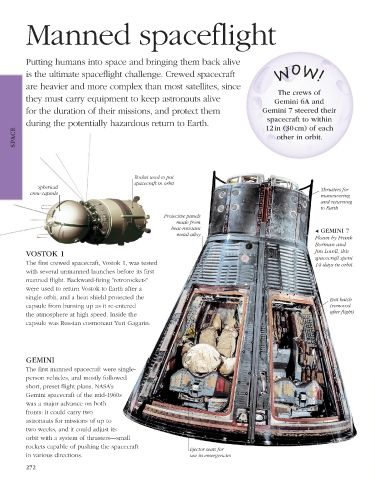
                                                         heat-resistant                                 ◀ GEMINI 7
                                                           metal alloy
                                                                                                        Flown by Frank
                                                                                                        Borman and
          VOSTOK 1                                                                                      Jim Lovell, this
                                                                                                        spacecraft spent
          The first crewed spacecraft, Vostok 1, was tested                                             14 days in orbit.
          with several unmanned launches before its first
          manned flight. Backward-firing “retrorockets”
          were used to return Vostok to Earth after a
          single orbit, and a heat shield protected the                                                      Exit hatch
          capsule from burning up as it re-entered                                                           (removed
          the atmosphere at high speed. Inside the                                                           after flight)
          capsule was Russian cosmonaut Yuri Gagarin.


          GEMINI
          The first manned spacecraft were single-
          person vehicles, and mostly followed
          short, preset flight plans. NASA’s
          Gemini spacecraft of the mid-1960s
          was a major advance on both
          fronts: it could carry two
          astronauts for missions of up to
          two weeks, and it could adjust its
          orbit with a system of thrusters—small
          rockets capable of pushing the spacecraft            Ejector seats for
          in various directions.                               use in emergencies
          272


   US_272-273_Manned_spaceflight_Main.indd   272                                                                 08/03/18   3:10 PM

