


Page 275 - Inventions - A Visual Encyclopedia (DK - Smithsonian)
P. 275
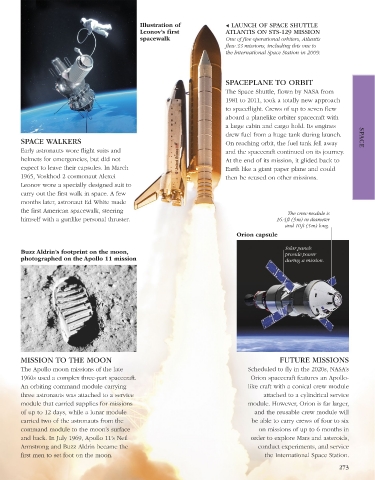
Illustration of             ◀ LAUNCH OF SPACE SHUTTLE
                                               Leonov’s first              ATLANTIS ON STS-129 MISSION
                                               spacewalk                   One of five operational orbiters, Atlantis
                                                                           flew 33 missions, including this one to
                                                                           the International Space Station in 2009.


                                                                           SPACEPLANE TO ORBIT
                                                                           The Space Shuttle, flown by NASA from
                                                                           1981 to 2011, took a totally new approach
                                                                           to spaceflight. Crews of up to seven flew
                                                                           aboard a planelike orbiter spacecraft with
                                                                           a large cabin and cargo hold. Its engines
                                                                           drew fuel from a huge tank during launch.
        SPACE WALKERS                                                      On reaching orbit, the fuel tank fell away   SPACE
        Early astronauts wore flight suits and                             and the spacecraft continued on its journey.
        helmets for emergencies, but did not                               At the end of its mission, it glided back to
        expect to leave their capsules. In March                           Earth like a giant paper plane and could
        1965, Voskhod 2 cosmonaut Alexei                                   then be reused on other missions.
        Leonov wore a specially designed suit to
        carry out the first walk in space. A few
        months later, astronaut Ed White made
        the first American spacewalk, steering                                                 The crew module is
        himself with a gunlike personal thruster.                                          16.4 ft (5 m) in diameter
                                                                                              and 10 ft (3 m) long.
                                                                              Orion capsule

                                                                                              Solar panels
        Buzz Aldrin’s footprint on the moon,                                                  provide power
        photographed on the Apollo 11 mission                                                 during a mission.


        MISSION TO THE MOON                                                                 FUTURE MISSIONS
        The Apollo moon missions of the late                                      Scheduled to fly in the 2020s, NASA’s
        1960s used a complex three-part spacecraft.                                Orion spacecraft features an Apollo-
        An orbiting command module carrying                                       like craft with a conical crew module
        three astronauts was attached to a service                                     attached to a cylindrical service
        module that carried supplies for missions                                 module. However, Orion is far larger,
        of up to 12 days, while a lunar module                                      and the reusable crew module will
        carried two of the astronauts from the                                     be able to carry crews of four to six
        command module to the moon’s surface                                          on missions of up to 6 months in
        and back. In July 1969, Apollo 11’s Neil                                   order to explore Mars and asteroids,
        Armstrong and Buzz Aldrin became the                                         conduct experiments, and service
        first men to set foot on the moon.                                              the International Space Station.
                                                                                                                273


   US_272-273_Manned_spaceflight_Main.indd   273                                                                 09/03/18   4:45 PM

