


Page 35 - (DK Eyewitness) Travel Guide - Hungary
P. 35
A POR TR AIT OF HUNGAR Y 33
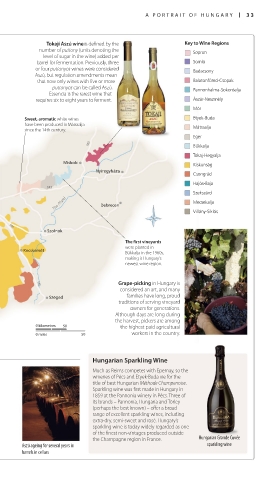
Tokaji Aszú wine is defined by the Key to Wine Regions
number of puttony (units denoting the Sopron
level of sugar in the wine) added per
barrel for fermentation. Previously, three Somló
or four puttonyos wines were considered Badacsony
Aszú, but regulation amendments mean
that now only wines with five or more Balatonfüred-Csopak
puttonyos can be called Aszú. Pannonhalma-Sokoróalja
Essencia is the rarest wine that
requires six to eight years to ferment. Ászár-Neszmély
Mór
Sweet, aromatic white wines Etyek-Buda
have been produced in Mátraalja
since the 14th century. Mátraalja
Eger
M3 Bükkalja
Tokaj-Hegyalja
Miskolc Kiskunság
Nyíregyháza
Csongrád
Hajós-Baja
M1
Győr M3
Sopron Szekszárd
M1
Tatabánya Mecsekalja
Budapest Tisa (Tisza) Debrecen
Villány-Siklós
M7
Székesfehérvar M5
Szombathely Szolnok
Danube (Duna) The first vineyards
Veszprém
were planted in
Zalaegerszeg Kecskemét Bükkalja in the 1960s,
Balaton making it Hungary’s
M7 newest wine region.
Nagykanizsa M5 Grape-picking in Hungary is
considered an art, and many
Szeged families have long, proud
traditions of serving vineyard
owners for generations.
Pécs Although days are long during
the harvest, pickers are among
0 kilometres 50 the highest paid agricultural
0 miles 50 workers in the country.
Hungarian Sparkling Wine
Much as Reims competes with Epernay, so the
wineries of Pécs and Etyek-Buda vie for the
title of best Hungarian Méthode Champenoise.
Sparkling wine was first made in Hungary in
1859 at the Pannonia winery in Pécs. Three of
its brands – Pannonia, Hungaria and Törley
(perhaps the best known) – offer a broad
range of excellent sparkling wines, including
extra-dry, semi-sweet and rosé. Hungary’s
sparkling wine is today widely regarded as one
of the finest non-vintages produced outside
the Champagne region in France. Hungarian Grande Cuvée
Aszú ageing for several years in sparkling wine
barrels in cellars
032-033_EW_Hungary.indd 33 18/09/17 3:39 pm

