


Page 426 - Tagalog for Beginners: An Introduction to Filipino, the National Language of the Philippines
P. 426
Appendix 1


            Speaking in Filipino: Notes on the Phonetic Features of the Language


            How  do  we  speak  Filipino?  To  this,  I  respond  with  the  most  basic  of  responses:
            “Ang bigkas ang siyang baybay, at ang baybay ang siyang bigkas.” Speak it the
            way it is spelled and spell it the way you speak it.

                 Here we’ll go over some general notes about the phonetics of the language, based
            on the writings of P/Filipino linguists, then we’ll explore guidelines from a popular
            expert,  and  finally,  we’ll  review  practical  tips  that  I  have  used  when  guiding  my
            students in the Filipino-language classroom.


            General Notes     1
            Filipino is not a tonal language. However, a word may change its meaning because

            of the change in stress.
                 It is, however, a phonetic language.
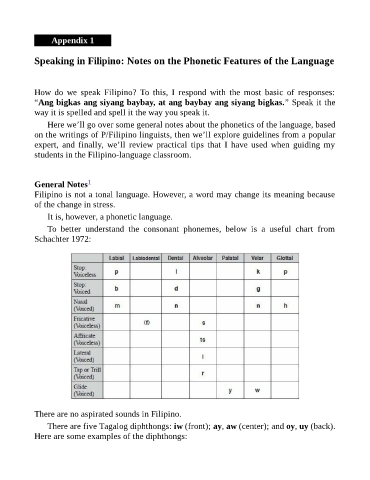
                 To  better  understand  the  consonant  phonemes,  below  is  a  useful  chart  from

            Schachter 1972:


            There are no aspirated sounds in Filipino.
                 There are five Tagalog diphthongs: iw (front); ay, aw (center); and oy, uy (back).
            Here are some examples of the diphthongs:

