


Page 427 - Tagalog for Beginners: An Introduction to Filipino, the National Language of the Philippines
P. 427
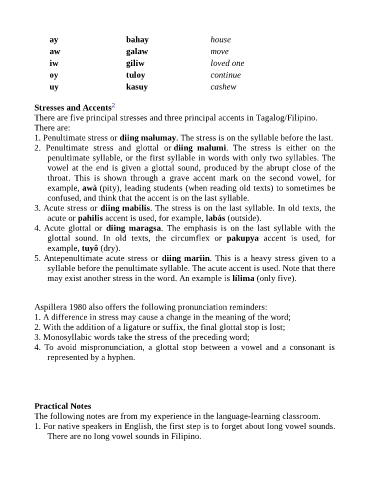
ay                        bahay                       house
                 aw                        galaw                       move
                 iw                        giliw                       loved one

                 oy                        tuloy                       continue
                 uy                        kasuy                       cashew


            Stresses and Accents      2
            There are five principal stresses and three principal accents in Tagalog/Filipino.
            There are:
            1. Penultimate stress or diing malumay. The stress is on the syllable before the last.
            2.  Penultimate  stress  and  glottal  or diing  malumi.  The  stress  is  either  on  the
                 penultimate syllable, or the first syllable in words with only two syllables. The
                 vowel at the end is given a glottal sound, produced by the abrupt close of the
                 throat.  This  is  shown  through  a  grave  accent  mark  on  the  second  vowel,  for
                 example, awà (pity), leading students (when reading old texts) to sometimes be
                 confused, and think that the accent is on the last syllable.
            3. Acute stress or diing mabilis. The stress is on the last syllable. In old texts, the
                 acute or pahilis accent is used, for example, labás (outside).
            4. Acute glottal or diing maragsa.  The  emphasis  is  on  the  last  syllable  with  the
                 glottal  sound.  In  old  texts,  the  circumflex  or  pakupya  accent  is  used,  for
                 example, tuyô (dry).

            5. Antepenultimate acute stress or diing mariin. This is a heavy stress given to a
                 syllable before the penultimate syllable. The acute accent is used. Note that there
                 may exist another stress in the word. An example is lílima (only five).


            Aspillera 1980 also offers the following pronunciation reminders:
            1. A difference in stress may cause a change in the meaning of the word;
            2. With the addition of a ligature or suffix, the final glottal stop is lost;
            3. Monosyllabic words take the stress of the preceding word;
            4.  To  avoid  mispronunciation,  a  glottal  stop  between  a  vowel  and  a  consonant  is
                 represented by a hyphen.


            Practical Notes
            The following notes are from my experience in the language-learning classroom.
            1. For native speakers in English, the first step is to forget about long vowel sounds.
                 There are no long vowel sounds in Filipino.

