


Page 35 - All About History - Issue 53-17
P. 35
Spies That Won WWII


          MARIAN

          REJEWSKI


          The Polish mathematician who
          reconstructed the Enigma cipher machine


          Significant early success in solving   Weeks before the German
          the cryptologic riddle of the   invasion of Poland that started World
          German Enigma cipher machine   War II, the Polish mathematicians      SCHOOL FOR
          was accomplished by a trio of Polish   met at Pyry, south of Warsaw,
          mathematicians in the 1930s. Marian   with British and French intelligence   SCOUNDRALS
          Rejewski, Henryk Zygalski, and   officers, revealing their successes.
          Jerzy Różycki collaborated in the   For British Intelligence, the progress   A step-by-step guide to the training of
          effort, and Rejewski actually made   of the Poles offered a great leap
          an Enigma machine in 1932 without   forward, allowing them to begin   Special Operations Executive hopefuls
          previously having seen one.    reading decrypted Enigma messages,
           Rejewski was born in 1905 in   dubbed Ultra, within months.  1. INTRODUCTORY COURSE
          Bromberg, at that time part of   The Poles continued working in   Those thought suitable for a role in the SOE were sent first on a two- or
          the German Empire. He attended   France until late 1942. Rejewski and   three-week course, where they would engage in physical fitness exercises,
          Poznan University during the 1920s,   Zygalski escaped to England the   basic map reading and weapons work, though the recruits were not told
          and while Polish cryptanalysts had   following summer and were enlisted   that they were testing for the SOE. There was also said to be a well-stocked
          worked on Enigma for a time, their   in the Polish Army, cracking other   bar to see how potential agents might behave when alcohol was liberally
          success had been limited. In the   German codes.             poured.
          autumn of 1932, the task was handed   Meanwhile, British and American
          to Rejewski.                cryptanalysts had taken the lead   2. GROUP A TRAINING
           Rejewski had only a general   in the decryption of Enigma   Those that passed the initial course were sent for a three- or four-week
          understanding of how the machine’s   transmissions. The Poles, who had   course in paramilitary techniques up in Scotland, most famously at Arisaig.
          system of rotors functioned and   provided vital assistance, were   Here they learned about small arms, as well taking lessons in unarmed
          received some assistance from   excluded from further participation.   combat (developed by former Shanghai police officers Sykes and Fairbairn),
                                                                       sabotage and demolition, intensive map reading and basic infantry tactical
          French sources. Within just a matter   Their role remained obscure for   training.
          of days, he managed to untangle the   some time. Rejewski died in 1980,
          labyrinth of internal wiring that made  aged 78. Twenty years later, he was   3. GROUP B TRAINING
          the Enigma a revolutionary encoding   awarded the Grand Cross of the   It was likely that the first two courses might wheedle out around 60 per
          machine with millions of possible   Order of Polonia Restituta, Poland’s   cent of candidates, the remainder passing on to Group B training in the
          letter combinations. The Poles   highest civilian decoration.  country houses around Beaulieu and the New Forest. Here they learned
          subsequently went on to pioneer                              defensive lessons — about enemy police services and how to respond to
          invaluable techniques for cracking                           their lines of questioning. They were also taught how to live their cover
          Enigma decryptions.                                          with conviction.
                                                                       4. GROUP B TESTING
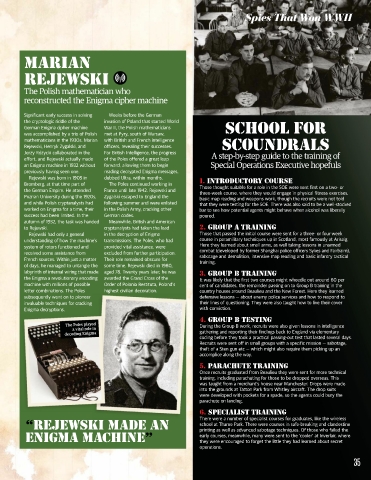
                        The Poles played                               During the Group B work, recruits were also given lessons in intelligence
                           a vital role in
                        decoding Enigma                                gathering and reporting their findings back to England via elementary
                                                                       coding before they took a practical passing-out test that lasted several days.
                                                                       Recruits were sent off in small groups with a specific mission — sabotage,
                                                                       theft of a Sten gun etc — which might also require them picking up an
                                                                       accomplice along the way.
                                                                       5. PARACHUTE TRAINING
                                                                       Once recruits graduated from Beaulieu they were sent for more technical
                                                                       training, including parachuting for those to be dropped overseas. This
                                                                       was taught from a merchant’s house near Manchester. Drops were made
                                                                       into the grounds at Tatton Park from Whitley aircraft. The drop suits
                                                                       were developed with pockets for a spade, so the agents could bury the
                                                                       parachute on landing.
                                                                       6. SPECIALIST TRAINING
          “REJEWSKI MADE AN                                            There were a number of specialist courses for graduates, like the wireless
                                                                       school at Thame Park. There were courses in safe-breaking and clandestine
          ENIGMA MACHINE”                                              printing as well as advanced sabotage techniques. Of those who failed the
                                                                       early courses, meanwhile, many were sent to the ‘cooler’ at Inverlair, where
                                                                       they were encouraged to forget the little they had learned about secret
                                                                       operations.
                                                                                                                             35

