


Page 38 - All About History - Issue 53-17
P. 38
Through History


        WEDDING DRESSES


            From intricate gowns to elaborate headpieces, take a look at the traditional
       wedding attire worn by brides from around the world and through the centuries

                                                                                                        .The Roman wedding dress was
                                                                                                         .designed to help protect the
                                                                              ROMAN VEIL 800 BCE           .bride from evil spirits
        RED SARI                                .Indian weddings are
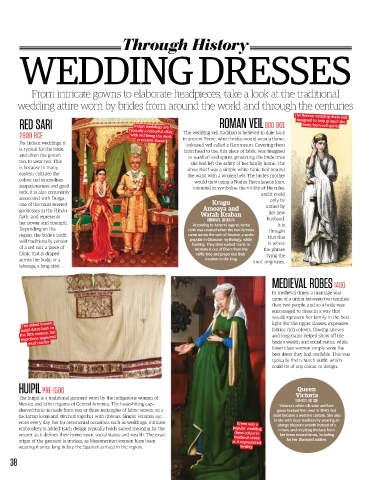
                                              .typically a colourful affair,   The wedding veil tradition is believed to date back
        2800 BCE                               .with red being the most
                                                 .prevalent shade  to ancient Rome, when brides would wear a flame-
        For Indian weddings, it
                                                                   coloured veil called a flammeum. Covering them
        is typical for the bride,                                 from head to toe, this piece of fabric was designed
        and often the groom                                        to ward off evil spirits, protecting the bride once
        too, to wear red. This                                      she had left the safety of her family home. The
        is because in many                                         dress itself was a simple white tunic tied around
        eastern cultures the
                                                                   the waist with a woolen belt. The bride’s mother
        colour red symbolises                                        would tie it using a Nodus Herculaneus knot,
        auspiciousness and good                                      intended to symbolise the virility of Hercules,
        luck. It is also commonly                                                            and it could
        associated with Durga,                                                                  only be
        one of the most revered                                             Krugu             untied by
        goddesses in the Hindu                                          Amoaya and             her new
        faith, and represents                                           Watah Kraban           husband.
                                                                          UNKNOWN, GHANAIAN
        her power and strength.                                      According to Ashanti legend, kente   It is
        Depending on the                                           cloth was created when the two farmers   thought
        region, the bride’s outfit                                 came across the web of Ananse, a spider   that this
        will traditionally consist                                  popular in Ghanaian mythology, while   is where
                                                                    hunting. They then rushed home to
        of a red sari, a piece of                                    recreate it out of fibers from the   the phrase
        fabric that is draped                                         raffia tree and presented their   ‘tying the
        across the body, or a                                            creation to the king.    knot’ originates.
        lehenga, a long skirt.


                                                                                                 MEDIEVAL ROBES 1400
                                                                                                 In medieval times, a marriage was
                                                                                                 more of a union between two families
                                                                                                 than two people, and so a bride was
                                                                                                 encouraged to dress in a way that
                                                                                                 would represent her family in the best
        .The oldest known                                                                        light. For the upper classes, expensive
        .huipil dates back to                                                                    fabrics, rich colours, flowing sleeves
        .the 18th century, but                                                                   and long trains helped show off the
        .depictions appeared
           .much earlier                                                                         bride’s wealth and social status, while
                                                                                                 lower class women simply wore the
                                                                                                 best dress they had available. This was
                                                                                                 typically their church outfit, which
                                                                                                 could be of any colour or design.


        HUIPIL PRE-1500                                                                                   Queen
        The huipil is a traditional garment worn by the indigenous women of                              Victoria
                                                                                                         1819-1901, BRITISH
        Mexico and other regions of Central America. The loose-fitting cap-                        Victoria’s white silk satin and lace
        sleeved tunic is made from two or three rectangles of fabric woven on a                   gown bucked the trend in 1840, but
        backstrap loom and stitched together with ribbons. Simple versions are                   soon became a western custom. She also
                                                                                                 broke with royal tradition by wearing an
        worn every day, but for ceremonial occasions such as weddings, intricate    Green was a    orange blossom wreath instead of a
        embroidery is added. Each design typically holds sacred meaning for the    popular wedding   crown, and recycling the lace from
        wearer, as it defines their home town, social status and wealth. The exact   dress colour in   her dress several times, including
                                                                                   medieval times
        origin of the garment is unclear, as Mesomerican women have been           as it represented   for her Diamond Jubilee.
        wearing it since long before the Spanish arrived in the region.              fertility
     38

