


Page 10 - (DK) The Dog Encyclopedia
P. 10
ALL ABOUT DOGS  |  EVOLUTION OF THE DOG


          Evolution of the dog


          There are an estimated 500 million domestic dogs worldwide, and all of them are related. At the
          base of their evolutionary tree stands the gray wolf, from which every type and breed of dog has
          descended. As geneticists have discovered, in terms of DNA, the difference between wolf and
          dog is infinitesimal. While natural selection has produced some of the changes that make one
          type of dog different from another, the effect of human influence has been far greater.
          It could be said that of the hundreds of modern dogs known today, all of them are man-made.


          DAWN OF THE DOG
          The history of the dog, and its transformation
          from wolf to domestic companion, goes back
          deep in prehistory, to the settlements of early
          hunter-gatherer peoples. In these primitive
          communities, wolves would scavenge among
          the litter around the camp site and were a
          useful source of hides and meat. The wolves
          might also, inadvertently, raise the alarm
          should an intruder or outsider approach the
          camp. Just why people first brought wolves
          into the domestic circle can perhaps be partly
          explained by the fact that humans in general
          seem programmed to adopt animals, either as
          playmates or status symbols. Possibly
          a small furry wolf cub appealed to our
          ancestors as much as it would to anyone
          today. Being social animals, wolves that
          became campside hangers-on may have
          readily made the transition between bonding   that a tame wolf with a sharp nose and a   Working together
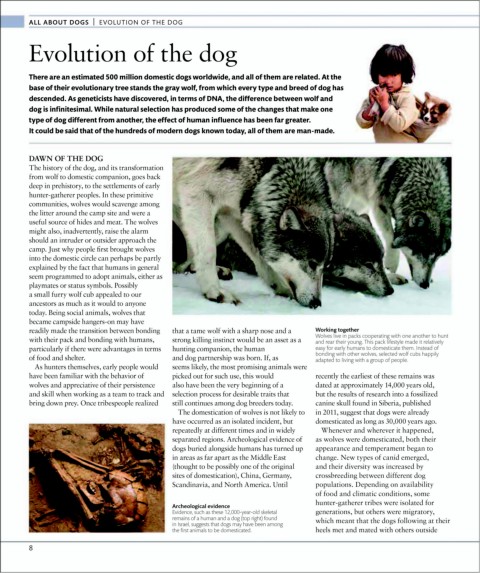
                                                                                               Wolves live in packs cooperating with one another to hunt
          with their pack and bonding with humans,   strong killing instinct would be an asset as a   and rear their young. This pack lifestyle made it relatively
          particularly if there were advantages in terms   hunting companion, the human        easy for early humans to domesticate them. Instead of
                                                                                               bonding with other wolves, selected wolf cubs happily
          of food and shelter.                      and dog partnership was born. If, as       adapted to living with a group of people.
           As hunters themselves, early people would   seems likely, the most promising animals were
          have been familiar with the behavior of   picked out for such use, this would        recently the earliest of these remains was
          wolves and appreciative of their persistence   also have been the very beginning of a   dated at approximately 14,000 years old,
          and skill when working as a team to track and  selection process for desirable traits that    but the results of research into a fossilized
          bring down prey. Once tribespeople realized   still continues among dog breeders today.    canine skull found in Siberia, published
                                                      The domestication of wolves is not likely to   in 2011, suggest that dogs were already
                                                    have occurred as an isolated incident, but   domesticated as long as 30,000 years ago.
                                                    repeatedly at different times and in widely   Whenever and wherever it happened,
                                                    separated regions. Archeological evidence of   as wolves were domesticated, both their
                                                    dogs buried alongside humans has turned up   appearance and temperament began to
                                                    in areas as far apart as the Middle East   change. New types of canid emerged,
                                                    (thought to be possibly one of the original   and their diversity was increased by
                                                    sites of domestication), China, Germany,   crossbreeding between different dog
                                                    Scandinavia, and North America. Until      populations. Depending on availability
                                                                                               of food and climatic conditions, some
                                                                                               hunter-gatherer tribes were isolated for
                                                    Archeological evidence
                                                    Evidence, such as these 12,000-year-old skeletal    generations, but others were migratory,
                                                    remains of a human and a dog (top right) found    which meant that the dogs following at their
                                                    in Israel, suggests that dogs may have been among
                                                    the first animals to be domesticated.       heels met and mated with others outside


          8

