


Page 11 - (DK) The Dog Encyclopedia
P. 11
EVOLUTION OF THE DOG


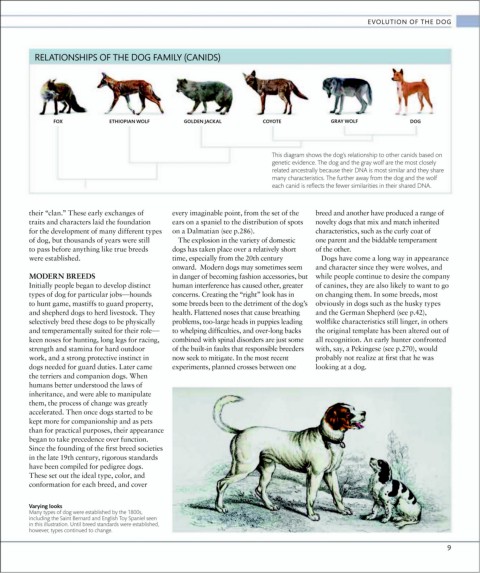
           RELATIONSHIPS OF THE DOG FAMILY (CANIDS)


                 FOX             ETHIOPIAN WOLF         GOLDEN JACKAL          COYOTE               GRAY WOLF              DOG


                                                                                  This diagram shows the dog’s relationship to other canids based on
                                                                                  genetic evidence. The dog and the gray wolf are the most closely
                                                                                  related ancestrally because their DNA is most similar and they share
                                                                                  many characteristics. The further away from the dog and the wolf
                                                                                  each canid is reflects the fewer similarities in their shared DNA.


          their “clan.” These early exchanges of    every imaginable point, from the set of the   breed and another have produced a range of
          traits and characters laid the foundation    ears on a spaniel to the distribution of spots   novelty dogs that mix and match inherited
          for the development of many different types   on a Dalmatian (see p.286).            characteristics, such as the curly coat of
          of dog, but thousands of years were still    The explosion in the variety of domestic   one parent and the biddable temperament
          to pass before anything like true breeds    dogs has taken place over a relatively short   of the other.
          were established.                         time, especially from the 20th century       Dogs have come a long way in appearance
                                                    onward.  Modern dogs may sometimes seem    and character since they were wolves, and
          MODERN BREEDS                             in danger of becoming fashion accessories, but  while people continue to desire the company
          Initially people began to develop distinct   human interference has caused other, greater   of canines, they are also likely to want to go
          types of dog for particular jobs—hounds    concerns. Creating the “right” look has in   on changing them. In some breeds, most
          to hunt game, mastiffs to guard property,    some breeds been to the detriment of the dog’s  obviously in dogs such as the husky types
          and shepherd dogs to herd livestock. They   health. Flattened noses that cause breathing   and the German Shepherd (see p.42),
          selectively bred these dogs to be physically   problems, too-large heads in puppies leading   wolflike characteristics still linger, in others
          and temperamentally suited for their role—  to whelping difficulties, and over-long backs   the original template has been altered out of
          keen noses for hunting, long legs for racing,   combined with spinal disorders are just some   all recognition. An early hunter confronted
          strength and stamina for hard outdoor     of the built-in faults that responsible breeders   with, say, a Pekingese (see p.270), would
          work, and a strong protective instinct in    now seek to mitigate. In the most recent   probably not realize at first that he was
          dogs needed for guard duties. Later came    experiments, planned crosses between one   looking at a dog.
          the terriers and companion dogs. When
          humans better understood the laws of
          inheritance, and were able to manipulate
          them, the process of change was greatly
          accelerated. Then once dogs started to be
          kept more for companionship and as pets
          than for practical purposes, their appearance
          began to take precedence over function.
          Since the founding of the first breed societies
          in the late 19th century, rigorous standards
          have been compiled for pedigree dogs.
          These set out the ideal type, color, and
          conformation for each breed, and cover


          Varying looks
          Many types of dog were established by the 1800s,
          including the Saint Bernard and English Toy Spaniel seen
          in this illustration. Until breed standards were established,
          however, types continued to change.


                                                                                                                                      9

