


Page 14 - (DK) The Dog Encyclopedia
P. 14
INTRODUCTION TO DOGS  |  SENSES


          Senses


          Dogs are very alert to their surroundings and highly responsive to sensory information. They
          look and listen to interpret their surroundings, just as we do. Although we see things with
          greater clarity—except at night, when canine vision is an advantage—dogs hear much more
          and possess a superbly developed sense of smell. A dog’s nose is his best asset and he relies on
          it to provide him with a detailed account of the world.


          SIGHT                                     distance vision. They are particularly quick
          Although dogs cannot see the range of color   to pick up movement and can even detect
          that humans can, they do see some colors.   lameness, a useful adaptation in a predatory
          This limited range is because a dog only    animal seeking an easy kill. Canines see best
          has two types of color-responsive cells   in the low light of dawn and dusk—prime
          (dichromatic vision) in the retina—the    times for hunting in the wild. With less acute
          light-sensitive layer at the back of the eye—  close vision, a dog relies more on scent,
          instead of three (trichromatic vision) as   or touch through his sensitive whiskers,
          humans have. The canine world is viewed    to investigate nearby objects.
          in shades of gray, blue, and yellow, without
          red, orange, or green—in much the same way
          as a person with red-green color-blindness.
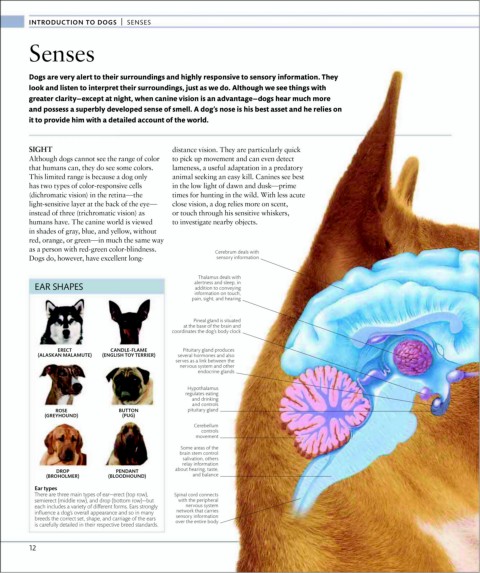
                                                                 Cerebrum deals with
          Dogs do, however, have excellent long-                 sensory information

                                                            Thalamus deals with
                                                           alertness and sleep, in
           EAR SHAPES                                      addition to conveying
                                                           information on touch,
                                                          pain, sight, and hearing


                                                           Pineal gland is situated
                                                        at the base of the brain and
                                                    coordinates the dog’s body clock


                  ERECT           CANDLE-FLAME         Pituitary gland produces
            (ALASKAN MALAMUTE)  (ENGLISH TOY TERRIER)  several hormones and also
                                                     serves as a link between the
                                                      nervous system and other
                                                            endocrine glands

                                                         Hypothalamus
                                                        regulates eating
                                                          and drinking
                                                          and controls
                 ROSE               BUTTON               pituitary gland
              (GREYHOUND)            (PUG)
                                                           Cerebellum
                                                             controls
                                                           movement
                                                       Some areas of the
                                                      brain stem control
                                                       salivation, others
                                                       relay information
                  DROP             PENDANT           about hearing, taste,
               (BROHOLMER)       (BLOODHOUND)             and balance
           Ear types
           There are three main types of ear—erect (top row),   Spinal cord connects
           semierect (middle row), and drop (bottom row)—but   with the peripheral
           each includes a variety of different forms. Ears strongly   nervous system
           influence a dog’s overall appearance and so in many   network that carries
                                                     sensory information
           breeds the correct set, shape, and carriage of the ears   over the entire body
           is carefully detailed in their respective breed standards.


          12

