


Page 12 - (DK) The Dog Encyclopedia
P. 12
INTRODUCTION TO DOGS  |  SKELETON AND MUSCLE


          Skeleton and muscle


          All mammals have a skeleton that is stabilized and given mobility by ligaments, tendons, and
          muscles. In dogs, this system evolved to serve their ancestral needs as fast-running carnivores.
          However, once domesticated, humans created different dogs for different tasks and in doing so
          altered their skeletons, too. Although some changes, such as dwarfism, result naturally from
          mutations, deliberate selection has created most of the variety seen in modern breeds today.


          SPECIALIZED SKELETON                      As a quadruped, a dog has four weight-     small bones in the dog’s wrist joint are fused
          Speed and agility are of prime importance   bearing legs. The forelegs have no bony   together, restricting rotation of the foot and
          for a predator. The prey sets the pace and   attachment, like the human collarbone   minimizing the likelihood of injury. For a
          direction of the chase and, for a successful   (clavicle), and are connected to the body only  hunter, this is important, since injury will
          outcome, a hunting dog has to be ready to   by muscles. This allows them to slide back   reduce hunting success and in serious cases
          move fast and turn within a split second.   and forth over the rib cage, increasing stride   would lead to starvation.
           Much of a dog’s speed relies on an       length. The long bones of the forelegs—the   Dogs have a characteristic “tiptoe” gait.
          extremely flexible spine, which bends and   radius and ulna—fit tightly together, unlike   There are four weight-bearing toes on each
          stretches easily with every stride. The   the equivalent bones in the human forearm.   foot and a vestigial dewclaw on the inside of
          powerful hindquarters provide forward     This is an essential adaptation in an animal
          propulsion, while adaptations to the forelegs   that may need to change direction rapidly
          increase stride length. Traction is created by   in pursuit of prey. The tight fit prevents
          the nonretractile claws, which act like the   rotation of the bones and reduces the risk
          running spikes on an athlete’s shoes.     of fracture. For extra stability, some of the


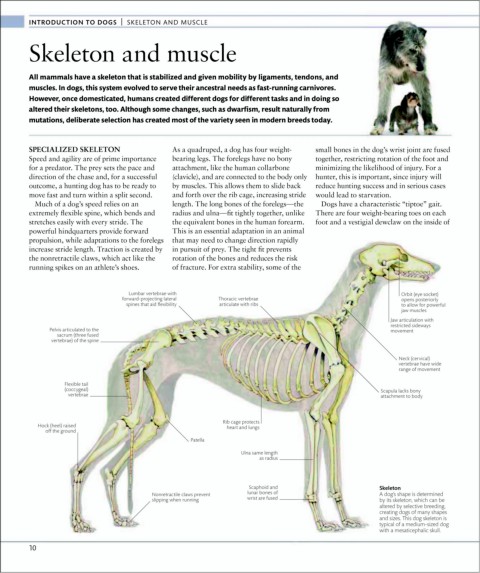
                                       Lumbar vertebrae with                                                             Orbit (eye socket)
                                     forward-projecting lateral   Thoracic vertebrae                                     opens posteriorly
                                       spines that aid flexibility  articulate with ribs                                  to allow for powerful
                                                                                                                         jaw muscles
                                                                                                                     Jaw articulation with
                                                                                                                     restricted sideways
                Pelvis articulated to the                                                                            movement
                  sacrum (three fused
                vertebrae) of the spine

                                                                                                                        Neck (cervical)
                                                                                                                        vertebrae have wide
                                                                                                                        range of movement

                    Flexible tail
                    (coccygeal)                                                                                   Scapula lacks bony
                     vertebrae                                                                                    attachment to body


                                                                   Rib cage protects
            Hock (heel) raised                                      heart and lungs
              off the ground
                                                          Patella
                                                                         Ulna same length
                                                                              as radius


                                                                           Scaphoid and                           Skeleton
                                                                           lunar bones of
                                              Nonretractile claws prevent                                         A dog’s shape is determined
                                              slipping when running        wrist are fused                        by its skeleton, which can be
                                                                                                                  altered by selective breeding,
                                                                                                                  creating dogs of many shapes
                                                                                                                  and sizes. This dog skeleton is
                                                                                                                  typical of a medium-sized dog
                                                                                                                  with a mesaticephalic skull.


          10

