Page 15 - (DK) The Dog Encyclopedia
P. 15
SENSES


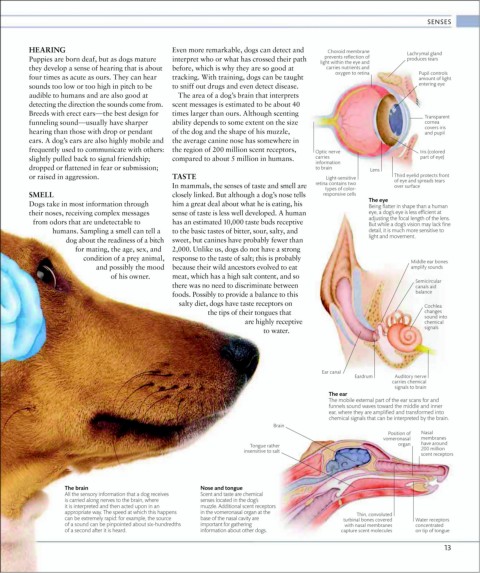
          HEARING                                   Even more remarkable, dogs can detect and      Choroid membrane       Lachrymal gland
          Puppies are born deaf, but as dogs mature   interpret who or what has crossed their path   prevents reflection of    produces tears
                                                                                                light within the eye and
          they develop a sense of hearing that is about   before, which is why they are so good at   carries nutrients and
                                                                                                     oxygen to retina         Pupil controls
          four times as acute as ours. They can hear   tracking. With training, dogs can be taught                            amount of light
          sounds too low or too high in pitch to be   to sniff out drugs and even detect disease.                             entering eye
          audible to humans and are also good at      The area of a dog’s brain that interprets
          detecting the direction the sounds come from.  scent messages is estimated to be about 40
          Breeds with erect ears—the best design for   times larger than ours. Although scenting
                                                                                                                                Transparent
          funneling sound—usually have sharper      ability depends to some extent on the size                                  cornea
                                                                                                                                covers iris
          hearing than those with drop or pendant   of the dog and the shape of his muzzle,                                     and pupil
          ears. A dog’s ears are also highly mobile and  the average canine nose has somewhere in
          frequently used to communicate with others:  the region of 200 million scent receptors,   Optic nerve               Iris (colored
          slightly pulled back to signal friendship;   compared to about 5 million in humans.  carries                        part of eye)
                                                                                               information
          dropped or flattened in fear or submission;                                           to brain        Lens
          or raised in aggression.                  TASTE                                         Light-sensitive     Third eyelid protects front
                                                                                                                      of eye and spreads tears
                                                    In mammals, the senses of taste and smell are   retina contains two   over surface
                                                                                                  types of color-
          SMELL                                     closely linked. But although a dog’s nose tells   responsive cells
                                                                                                               The eye
          Dogs take in most information through     him a great deal about what he is eating, his              Being flatter in shape than a human
          their noses, receiving complex messages   sense of taste is less well developed. A human             eye, a dog’s eye is less efficient at
                                                                                                               adjusting the focal length of the lens.
           from odors that are undetectable to      has an estimated 10,000 taste buds receptive               But while a dog’s vision may lack fine
                 humans. Sampling a smell can tell a   to the basic tastes of bitter, sour, salty, and         detail, it is much more sensitive to
                                                                                                               light and movement.
                     dog about the readiness of a bitch  sweet, but canines have probably fewer than
                       for mating, the age, sex, and   2,000. Unlike us, dogs do not have a strong
                          condition of a prey animal,  response to the taste of salt; this is probably
                                                                                                                           Middle ear bones
                              and possibly the mood  because their wild ancestors evolved to eat                           amplify sounds
                                  of his owner.     meat, which has a high salt content, and so
                                                                                                                             Semicircular
                                                    there was no need to discriminate between                                canals aid
                                                    foods. Possibly to provide a balance to this                             balance
                                                      salty diet, dogs have taste receptors on
                                                                                                                               Cochlea
                                                               the tips of their tongues that                                  changes
                                                                                                                               sound into
                                                                          are highly receptive                                 chemical
                                                                                                                               signals
                                                                               to water.


                                                                                                 Ear canal
                                                                                                           Eardrum     Auditory nerve
                                                                                                                      carries chemical
                                                                                                                       signals to brain
                                                                                                   The ear
                                                                                                   The mobile external part of the ear scans for and
                                                                                                   funnels sound waves toward the middle and inner
                                                                                                   ear, where they are amplified and transformed into
                                                                                                   chemical signals that can be interpreted by the brain.
                                                                                  Brain
                                                                                                                     Position of   Nasal
                                                                                                                   vomeronasal  membranes
                                                                           Tongue rather                                organ  have around
                                                                          insensitive to salt                                 200 million
                                                                                                                              scent receptors


                    The brain                                Nose and tongue
                    All the sensory information that a dog receives    Scent and taste are chemical
                    is carried along nerves to the brain, where    senses located in the dog’s
                    it is interpreted and then acted upon in an    muzzle. Additional scent receptors
                    appropriate way. The speed at which this happens    in the vomeronasal organ at the    Thin, convoluted
                    can be extremely rapid: for example, the source    base of the nasal cavity are    turbinal bones covered   Water receptors
                    of a sound can be pinpointed about six-hundredths    important for gathering        with nasal membranes   concentrated
                    of a second after it is heard.           information about other dogs.             capture scent molecules  on tip of tongue


                                                                                                                                     13
   10   11   12   13   14   15   16   17   18   19   20