


Page 13 - (DK) The Dog Encyclopedia
P. 13
SKELETON AND MUSCLE


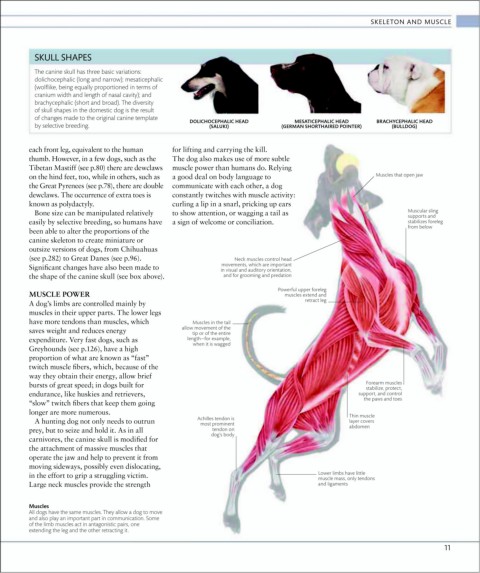
           SKULL SHAPES

           The canine skull has three basic variations:
           dolichocephalic (long and narrow); mesaticephalic
           (wolflike, being equally proportioned in terms of
           cranium width and length of nasal cavity); and
           brachycephalic (short and broad). The diversity
           of skull shapes in the domestic dog is the result
           of changes made to the original canine template
                                                         DOLICHOCEPHALIC HEAD            MESATICEPHALIC HEAD     BRACHYCEPHALIC HEAD
           by selective breeding.                              (SALUKI)              (GERMAN SHORTHAIRED POINTER)     (BULLDOG)

          each front leg, equivalent to the human   for lifting and carrying the kill.
          thumb. However, in a few dogs, such as the   The dog also makes use of more subtle
          Tibetan Mastiff (see p.80) there are dewclaws   muscle power than humans do. Relying
          on the hind feet, too, while in others, such as   a good deal on body language to                      Muscles that open jaw
          the Great Pyrenees (see p.78), there are double  communicate with each other, a dog
          dewclaws. The occurrence of extra toes is   constantly twitches with muscle activity:
          known as polydactyly.                     curling a lip in a snarl, pricking up ears
           Bone size can be manipulated relatively   to show attention, or wagging a tail as                              Muscular sling
                                                                                                                          supports and
          easily by selective breeding, so humans have   a sign of welcome or conciliation.                               stabilizes foreleg
                                                                                                                          from below
          been able to alter the proportions of the
          canine skeleton to create miniature or
          outsize versions of dogs, from Chihuahuas
          (see p.282) to Great Danes (see p.96).                       Neck muscles control head
                                                                   movements, which are important
          Significant changes have also been made to
                                                                   in visual and auditory orientation,
          the shape of the canine skull (see box above).            and for grooming and predation
                                                                                    Powerful upper foreleg
          MUSCLE POWER                                                                muscles extend and
                                                                                            retract leg
          A dog’s limbs are controlled mainly by
          muscles in their upper parts. The lower legs
          have more tendons than muscles, which           Muscles in the tail
          saves weight and reduces energy              allow movement of the
                                                          tip or of the entire
          expenditure. Very fast dogs, such as           length—for example,
                                                          when it is wagged
          Greyhounds (see p.126), have a high
          proportion of what are known as “fast”
          twitch muscle fibers, which, because of the
          way they obtain their energy, allow brief
          bursts of great speed; in dogs built for                                                            Forearm muscles
                                                                                                              stabilize, protect,
          endurance, like huskies and retrievers,                                                           support, and control
                                                                                                             the paws and toes
          “slow” twitch fibers that keep them going
          longer are more numerous.
                                                                                                         Thin muscle
           A hunting dog not only needs to outrun           Achilles tendon is                           layer covers
                                                             most prominent                              abdomen
          prey, but to seize and hold it. As in all             tendon on
                                                                dog’s body
          carnivores, the canine skull is modified for
          the attachment of massive muscles that
          operate the jaw and help to prevent it from
          moving sideways, possibly even dislocating,
          in the effort to grip a struggling victim.                                            Lower limbs have little
                                                                                                muscle mass, only tendons
          Large neck muscles provide the strength                                               and ligaments


          Muscles
          All dogs have the same muscles. They allow a dog to move
          and also play an important part in communication. Some
          of the limb muscles act in antagonistic pairs, one
          extending the leg and the other retracting it.


                                                                                                                                     11

