


Page 17 - (DK) The Dog Encyclopedia
P. 17
CARDIOVASCULAR AND DIGESTIVE SYSTEMS


          Where the blood flows in and out of the
          paws, the arteries and veins are in very close   TEETH
          proximity. As warm arterial blood passes
                                                      By the age of 7 to 8 months, most dogs        Carnassial
          into the paws, it transfers its heat to the
                                                      have a full set of 42 adult teeth, all           teeth
          cooler returning venous blood, so the heat
                                                      adapted for eating meat. At the front,   Hidden
          is retained in the body rather than lost to    the upper and lower jaws have six   canine root
          the environment. Known as counter-current   incisors flanked at either side by a   Incisor
          heat exchange, the same mechanism           single large canine tooth that was    tooth
                                                      once used for grasping, holding, and
          operates in the skin of walruses and in
                                                      piercing prey. Along the sides of the
          penguins’ feet, allowing them to survive
                                                      jaws are the premolars and molars.
          in freezing polar environments.             The fourth upper premolar and lower
                                                      first molar on each side of the jaw are
          DIGESTING FOOD                              called carnassial teeth and are a feature
          A healthy dog wastes no time in clearing its   of all mammals belonging to the   Canine
                                                      Carnivora order. These teeth act like a   tooth
          food bowl, gulping down one mouthful
                                                      pair of scissors and are used for cutting
          after another without stopping to chew                                                    Premolars  Molars
                                                      and shearing through hide and bone.
          anything. Canids are programmed to eat fast,
          not out of greed but out of necessity—in the
          wild the slowest feeder risks losing its meal to  process of digestion even before swallowing.   much more quickly and easily digested than
          ravenous pack mates. Humans tend to savor   Dogs, which have relatively few taste buds   plant material. A dog’s stomach contains
          the food in their mouths, chewing it and   compared to humans, simply grab large     high levels of digestive acids that break
          mixing it well with saliva, which starts the   chunks of food and swallow them whole. To   down meat, bone, and fat rapidly, reducing
                                                    mitigate this, they also have an excellent gag   food to a liquid that then passes into the
                                                    reflex. If they eat something unpleasant they   small intestine. Once there, digestive
             Sharp teeth bite off lumps                can simply throw it up.                 enzymes produced by the liver and pancreas
             of meat, which are mixed
             with saliva and swallowed                          The canine digestive tract is   aid the breakdown of food into nutrients
              whole without chewing
                                                                short and designed specifically   that can be absorbed into the bloodstream
                                                                 for processing meat, which is   through the intestinal walls. Any undigested
                                                                                               material moves through the large intestine
                                                                                               to be eliminated as feces. In dogs, the transit
                                                                       Pancreas produces more
                                                                    enzymes and substances that   time of food through the digestive tract,
                                                                   neutralize the stomach acid on
                                                                        entering the duodenum  from eating to elimination, takes around
                                                                                                  8 to 9 hours, compared with an average
                                                                                                        of 36 to 48 hours in humans.
                Muscular contractions of
                 the esophagus move the
                 lumps of food down into
                        the stomach


                   Stomach has rings of muscle at its
                 entrance (cardiac sphincter) and exit                                                                Large intestine absorbs
             (pyloric sphincter) and produces enzymes,                                                                excess liquid. Feces are
                                                                                                                      formed and are passed
              and mucus that coats its walls, protecting                                                              from the body
               them from the acid it produces to break
                    down the fibrous tissue in meat
                         Liver produces bile to help break
                         down fat into molecules that can
                          then be absorbed by the blood
                                                                       Nutrients are absorbed
                                                                      through the walls of the
                                                                       small intestine into the
                                                                             bloodstream


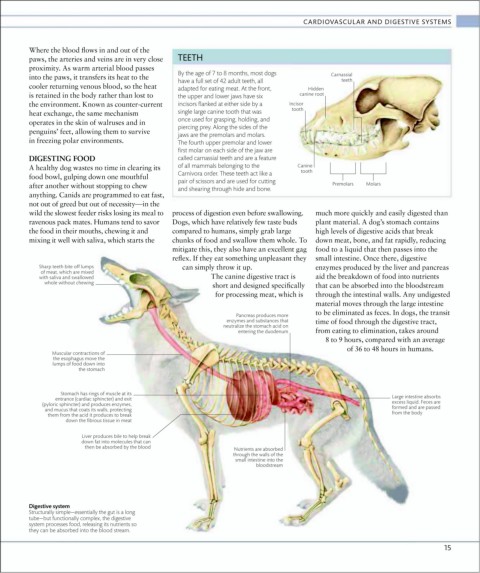
          Digestive system
          Structurally simple—essentially the gut is a long
          tube—but functionally complex, the digestive
          system processes food, releasing its nutrients so
          they can be absorbed into the blood stream.


                                                                                                                                     15

