


Page 19 - (DK) The Dog Encyclopedia
P. 19
URINARY, REPRODUCTIVE, AND HORMONAL SYSTEMS


          REPRODUCTION                              Anything from one to fourteen or more
          Dogs usually reach sexual maturity        puppies may be born, but a litter of six     HORMONES IN
          somewhere between 6 and 12 months of age.  to eight is the average.                    PREGNANCY
          In wild canines such as the wolf, females
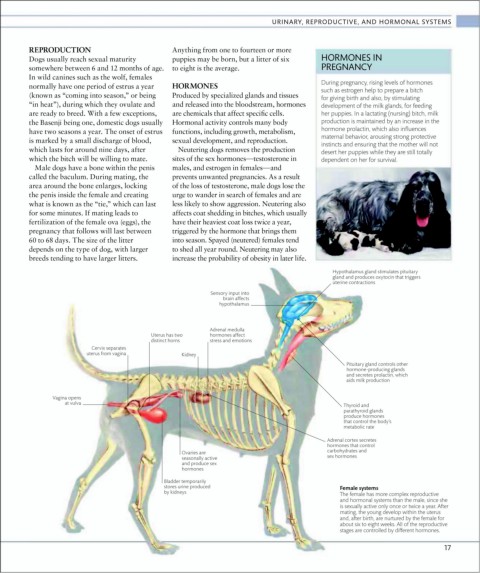
                                                                                                 During pregnancy, rising levels of hormones
          normally have one period of estrus a year   HORMONES
                                                                                                 such as estrogen help to prepare a bitch
          (known as “coming into season,” or being   Produced by specialized glands and tissues
                                                                                                 for giving birth and also, by stimulating
          “in heat”), during which they ovulate and   and released into the bloodstream, hormones   development of the milk glands, for feeding
          are ready to breed. With a few exceptions,   are chemicals that affect specific cells.   her puppies. In a lactating (nursing) bitch, milk
          the Basenji being one, domestic dogs usually   Hormonal activity controls many body    production is maintained by an increase in the
          have two seasons a year. The onset of estrus   functions, including growth, metabolism,   hormone prolactin, which also influences
                                                                                                 maternal behavior, arousing strong protective
          is marked by a small discharge of blood,   sexual development, and reproduction.
                                                                                                 instincts and ensuring that the mother will not
          which lasts for around nine days, after     Neutering dogs removes the production      desert her puppies while they are still totally
          which the bitch will be willing to mate.   sites of the sex hormones—testosterone in   dependent on her for survival.
           Male dogs have a bone within the penis   males, and estrogen in females—and
          called the baculum. During mating, the    prevents unwanted pregnancies. As a result
          area around the bone enlarges, locking    of the loss of testosterone, male dogs lose the
          the penis inside the female and creating   urge to wander in search of females and are
          what is known as the “tie,” which can last   less likely to show aggression. Neutering also
          for some minutes. If mating leads to      affects coat shedding in bitches, which usually
          fertilization of the female ova (eggs), the   have their heaviest coat loss twice a year,
          pregnancy that follows will last between    triggered by the hormone that brings them
          60 to 68 days. The size of the litter     into season. Spayed (neutered) females tend
          depends on the type of dog, with larger   to shed all year round. Neutering may also
          breeds tending to have larger litters.    increase the probability of obesity in later life.
                                                                                                    Hypothalamus gland stimulates pituitary
                                                                                                    gland and produces oxytocin that triggers
                                                                                                    uterine contractions
                                                                Sensory input into
                                                                   brain affects
                                                                  hypothalamus


                                                               Adrenal medulla
                                              Uterus has two   hormones affect
                                              distinct horns   stress and emotions
                            Cervix separates
                           uterus from vagina          Kidney
                                                                                                        Pituitary gland controls other
                                                                                                        hormone-producing glands
                                                                                                        and secretes prolactin, which
                                                                                                        aids milk production


                 Vagina opens
                    at vulva
                                                                                                       Thyroid and
                                                                                                       parathyroid glands
                                                                                                       produce hormones
                                                                                                       that control the body’s
                                                                                                       metabolic rate
                                                                                                  Adrenal cortex secretes
                                                                                                  hormones that control
                                                                                                  carbohydrates and
                                                       Ovaries are
                                                       seasonally active                          sex hormones
                                                       and produce sex
                                                       hormones
                                                  Bladder temporarily
                                                  stores urine produced                               Female systems
                                                  by kidneys                                          The female has more complex reproductive
                                                                                                      and hormonal systems than the male, since she
                                                                                                      is sexually active only once or twice a year. After
                                                                                                      mating, the young develop within the uterus
                                                                                                      and, after birth, are nurtured by the female for
                                                                                                      about six to eight weeks. All of the reproductive
                                                                                                      stages are controlled by different hormones.


                                                                                                                                     17

