


Page 24 - Shark
P. 24
Live young


                           The majority of sharks give birth to live young instead of laying
                                eggs. Most are ovoviviparous, producing large yolky eggs that are kept
                                 inside the mother’s uterus. The developing pup, or embryo, is fed by
                                 the yolk sac attached to its belly. When this is used up, the pup
                                is fully developed and ready to be born. In some shark species, the
                                first pups that develop eat eggs and also embryos in their mother’s
                               uterus. In sand tiger (pp. 24–25) and mako sharks, only one of the
                             young cannibals survives in each side of the paired uteri, having eaten
        Mother and baby   all its unborn brothers and sisters. A more complex pregnancy occurs
        Human babies need
        to be looked after for   in a few viviparous sharks, such as lemon (pp. 54–55), blue, and bull, as
          many years, but
         shark pups are not   well as hammerhead (pp. 42–43) sharks, in which nourishment from the
           so lucky. They   mother’s blood passes through the placenta to the embryo via the umbilical
           must fend for
         themselves as soon   cord. This is also how human babies develop, as well as other placental
          as they are born.  mammals, such as dogs and elephants.

                1


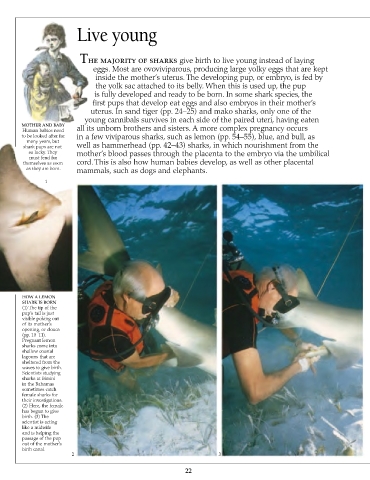
        how a leMon
        shark is born
        (1) The tip of the
        pup’s tail is just
        visible poking out
        of its mother’s
        opening, or cloaca
        (pp. 10–11).
        Pregnant lemon
        sharks come into
        shallow coastal
        lagoons that are
        sheltered from the
        waves to give birth.
        Scientists studying
        sharks at Bimini
        in the Bahamas
        sometimes catch
        female sharks for
        their investigations.
        (2) Here, the female
        has begun to give
        birth. (3) The
        scientist is acting
        like a midwife
        and is helping the
        passage of the pup
        out of the mother’s
        birth canal.
                         2                                               3

                                                              22

