


Page 20 - Shark
P. 20
Blue shark’s
                       nictitating           Making sense
                           eyelid  Sensory
                                  pores


                                              Sharks have the same five senses as people—
                                                    they can see, hear, smell, taste, and touch.
                                                           There is also a sixth sense that            Metal detector
                                                                allows sharks to detect weak,           Sweeping a metal
                                                                electrical signals generated by       detector back and forth
                                                                                                       to find buried metal
                                                                their prey. This electro-sense          objects is like the
                                                                                                       way hammerheads
                                                              may also help them to navigate           (pp. 42–43) hunt for
                                                 on their journeys in the sea. This underwater        fish hiding in the sand.
                                  Nostril  world is quite different from our own. Light levels
                                           decrease with depth and colors fade to blues. Sound travels five times
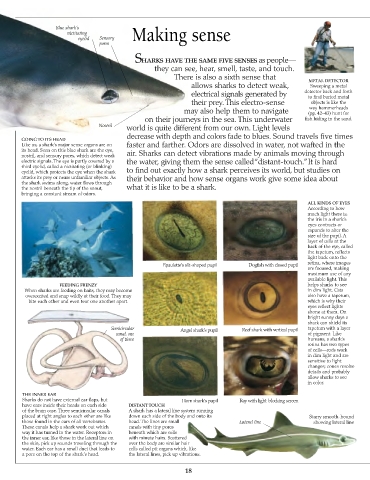
        GoinG to its head
        Like us, a shark’s major sense organs are on   faster and farther. Odors are dissolved in water, not wafted in the
        its head. Seen on this blue shark are the eye,   air. Sharks can detect vibrations made by animals moving through
        nostril, and sensory pores, which detect weak
        electric signals. The eye is partly covered by a   the water, giving them the sense called “distant-touch.” It is hard
        third eyelid, called a nictitating (or blinking)
        eyelid, which protects the eye when the shark   to find out exactly how a shark perceives its world, but studies on
        attacks its prey or nears unfamiliar objects. As   their behavior and how sense organs work give some idea about
        the shark swims along, water flows through
        the nostril beneath the tip of the snout,   what it is like to be a shark.
        bringing a constant stream of odors.
                                                                                                       all kinds oF eyes
                                                                                                       According to how
                                                                                                       much light there is,
                                                                                                       the iris in a shark’s
                                                                                                       eyes contracts or
                                                                                                       expands to alter the
                                                                                                       size of the pupil. A
                                                                                                       layer of cells at the
                                                                                                       back of the eye, called
                                                                                                       the tapetum, reflects
                                                                                                       light back onto the
                                                       Epaulette’s slit-shaped pupil  Dogfish with closed pupil  retina, where images
                                                                                                       are focused, making
                                                                                                       maximum use of any
                                                                                                       available light. This
                     FeedinG Frenzy                                                                    helps sharks to see
         When sharks are feeding on baits, they may become                                             in dim light. Cats
         overexcited and snap wildly at their food. They may                                           also have a tapetum,
           bite each other and even tear one another apart.                                            which is why their
                                                                                                       eyes reflect lights
                                                                                                       shone at them. On
                                                                                                       bright sunny days a
                                                                                                       shark can shield its
                                      Semicircular           Angel shark’s pupil  Reef shark with vertical pupil  tapetum with a layer
                                       canal, one                                                      of pigment. Like
                                         of three                                                      humans, a shark’s
                                                                                                       retina has two types
                                                                                                       of cells—rods work
                                                                                                       in dim light and are
                                                                                                       sensitive to light
                                                                                                       changes; cones resolve
                                                                                                       details and probably
                                                                                                       allow sharks to see
                                                                                                       in color.

        the inner ear
        Sharks do not have external ear flaps, but           Horn shark’s pupil  Ray with light-blocking screen
        have ears inside their heads on each side   distant touch
        of the brain case. Three semicircular canals   A shark has a lateral line system running
        placed at right angles to each other are like   down each side of the body and onto its        Starry smooth-hound
        those found in the ears of all vertebrates.   head. The lines are small   Lateral line           showing lateral line
        These canals help a shark work out which   canals with tiny pores
        way it has turned in the water. Receptors in   beneath which are cells
        the inner ear, like those in the lateral line on   with minute hairs. Scattered
        the skin, pick up sounds traveling through the   over the body are similar hair
        water. Each ear has a small duct that leads to   cells called pit organs which, like
        a pore on the top of the shark’s head.  the lateral lines, pick up vibrations.

                                                              18

