


Page 21 - Shark
P. 21
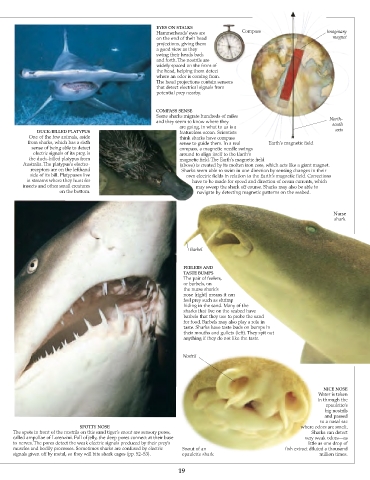
eyes on stalks
                                                     Hammerheads’ eyes are       Compass                     Imaginary
                                                     on the end of their head                                  magnet
                                                     projections, giving them
                                                     a good view as they
                                                     swing their heads back
                                                     and forth. The nostrils are
                                                     widely spaced on the front of
                                                     the head, helping them detect
                                                     where an odor is coming from.
                                                     The head projections contain sensors
                                                     that detect electrical signals from
                                                     potential prey nearby.

                                                     coMpass sense
                                                     Some sharks migrate hundreds of miles
                                                     and they seem to know where they                         North-
                                                            are going, in what to us is a                      south
             duck-billed platypus                           featureless ocean. Scientists                       axis
           One of the few animals, aside                    think sharks have compass
          from sharks, which has a sixth                    sense to guide them. In a real   Earth’s magnetic field
           sense of being able to detect                    compass, a magnetic needle swings
            electric signals of its prey, is                around to align itself to the Earth’s
           the duck-billed platypus from                    magnetic field. The Earth’s magnetic field
         Australia. The platypus’s electro-                 (above) is created by its molten iron core, which acts like a giant magnet.
           receptors are on the lefthand                     Sharks seem able to swim in one direction by sensing changes in their
           side of its bill. Platypuses live                   own electric fields in relation to the Earth’s magnetic field. Corrections
          in streams where they hunt for                         have to be made for speed and direction of ocean currents, which
         insects and other small creatures                        may sweep the shark off course. Sharks may also be able to
                     on the bottom.                               navigate by detecting magnetic patterns on the seabed.


                                                                                                               Nurse
                                                                                                                shark


                                                                Barbel


                                                              Feelers and
                                                              taste buMps
                                                              The pair of feelers,
                                                              or barbels, on
                                                              the nurse shark’s
                                                              nose (right) means it can
                                                              feel prey such as shrimp
                                                              hiding in the sand. Many of the
                                                              sharks that live on the seabed have
                                                              barbels that they use to probe the sand
                                                              for food. Barbels may also play a role in
                                                              taste. Sharks have taste buds on bumps in
                                                              their mouths and gullets (left). They spit out
                                                              anything if they do not like the taste.


                                                              Nostril


                                                                                                            nice nose
                                                                                                          Water is taken
                                                                                                          in through the
                                                                                                             epaulette’s
                                                                                                             big nostrils
                                                                                                            and passed
                                                                                                           to a nasal sac
                           spotty nose                                                               where odors are smelt.
     The spots in front of the nostrils on this sand tiger’s snout are sensory pores,                   Sharks can detect
     called ampullae of Lorenzini. Full of jelly, the deep pores connect at their base                very weak odors—as
     to nerves. The pores detect the weak electric signals produced by their prey’s                    little as one drop of
     muscles and bodily processes. Sometimes sharks are confused by electric   Snout of an     fish extract diluted a thousand
     signals given off by metal, so they will bite shark cages (pp. 52–53).  epaulette shark               million times.

                                                            19

