


Page 19 - Shark
P. 19
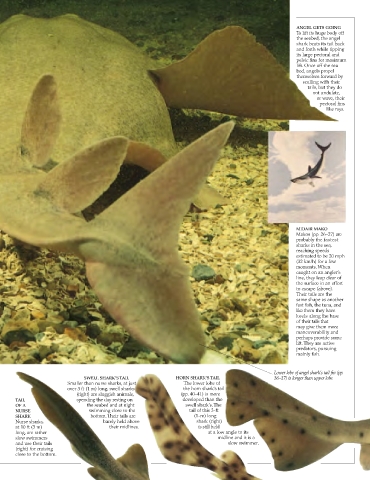
anGel Gets GoinG
                                                                                                   To lift its huge body off
                                                                                                   the seabed, the angel
                                                                                                   shark beats its tail back
                                                                                                   and forth while tipping
                                                                                                   its large pectoral and
                                                                                                   pelvic fins for maximum
                                                                                                   lift. Once off the sea
                                                                                                   bed, angels propel
                                                                                                   themselves forward by
                                                                                                     sculling with their
                                                                                                       tails, but they do
                                                                                                        not undulate,
                                                                                                          or wave, their
                                                                                                           pectoral fins
                                                                                                             like rays.


                                                                                                   Midair Mako
                                                                                                   Makos (pp. 26–27) are
                                                                                                   probably the fastest
                                                                                                   sharks in the sea,
                                                                                                   reaching speeds
                                                                                                   estimated to be 20 mph
                                                                                                   (32 km/h) for a few
                                                                                                   moments. When
                                                                                                   caught on an angler’s
                                                                                                   line, they leap clear of
                                                                                                   the surface in an effort
                                                                                                   to escape (above).
                                                                                                   Their tails are the
                                                                                                   same shape as another
                                                                                                   fast fish, the tuna, and
                                                                                                   like them they have
                                                                                                   keels along the base
                                                                                                   of their tails that
                                                                                                   may give them more
                                                                                                   maneuverability and
                                                                                                   perhaps provide some
                                                                                                   lift. They are active
                                                                                                   predators, pursuing
                                                                                                   mainly fish.

                                                                                            Lower lobe of angel shark’s tail fin (pp.
                             swell shark’s tail            horn shark’s tail                36–37) is longer than upper lobe
                       Smaller than nurse sharks, at just     The lower lobe of
                       over 3 ft (1 m) long, swell sharks     the horn shark’s tail
                          (right) are sluggish animals,      (pp. 40–41) is more
      tail                spending the day resting on        developed than the
      of a                    the seabed and at night         swell shark’s. The
      nurse                   swimming close to the             tail of this 3-ft
      shark                    bottom. Their tails are           (1-m) long
      Nurse sharks,                barely held above              shark (right)
      at 10 ft (3 m)                 their midlines.               is still held
      long, are rather                                                at a low angle to its
      slow swimmers                                                      midline and it is a
      and use their tails                                                   slow swimmer.
      (right) for cruising
      close to the bottom.

