


Page 56 - Shark
P. 56
Studying sharks


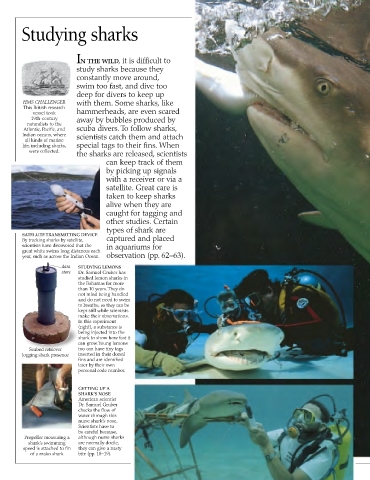
                          In the wild, it is difficult to
                          study sharks because they
                          constantly move around,
                          swim too fast, and dive too
                          deep for divers to keep up
         HMS cHallenger   with them. Some sharks, like
         This British research
            vessel took    hammerheads, are even scared
           19th-century   away by bubbles produced by
          naturalists to the
         Atlantic, Pacific, and   scuba divers. To follow sharks,
        Indian oceans, where   scientists catch them and attach
         all kinds of marine
        life, including sharks,   special tags to their fins. When
           were collected.  the sharks are released, scientists
                                    can keep track of them
                                    by picking up signals
                                    with a receiver or via a
                                    satellite. Great care is
                                    taken to keep sharks
                                    alive when they are
                                    caught for tagging and
                                    other studies. Certain
                                    types of shark are
        Satellite tranSmitting device
        By tracking sharks by satellite,   captured and placed
        scientists have discovered that the   in aquariums for
        great white swims long distances each
        year, such as across the Indian Ocean.  observation (pp. 62–63).
                     data   Studying lemonS
                     store  Dr. Samuel Gruber has
                           studied lemon sharks in
                           the Bahamas for more
                           than 10 years. They do
                           not mind being handled
                           and do not need to swim
                           to breathe, so they can be
                           kept still while scientists
                           make their observations.
                           In this experiment
                           (right), a substance is
                           being injected into the
                           shark to show how fast it
                           can grow. Young lemons
           Seabed retriever   too can have tiny tags
        logging shark presence  inserted in their dorsal
                           fins and are identified
                           later by their own
                           personal code number.


                           getting up a
                           Shark’S noSe
                           American scientist
                           Dr. Samuel Gruber
                           checks the flow of
                           water through this
                           nurse shark’s nose.
                           Scientists have to
                           be careful because,
         Propeller measuring a    although nurse sharks
          shark’s swimming   are normally docile,
         speed is attached to fin   they can give a nasty
           of a mako shark  bite (pp. 18–19).

