


Page 60 - Shark
P. 60
Shark overkill


        People kill sharks for their meat,
        fins, skin, and liver oil, as well as for
        pure sport. Sport fishing can reduce
        numbers of sharks locally, but the
        biggest threat to sharks is overfishing
        worldwide. Sharks, caught on long
        lines and in fishing nets, are often
        thrown back into the sea dead,
        because it is other fish hauled in
        at the same time that are wanted.
        Sometimes, just the shark’s fins                       Angling             WAlls of deAth
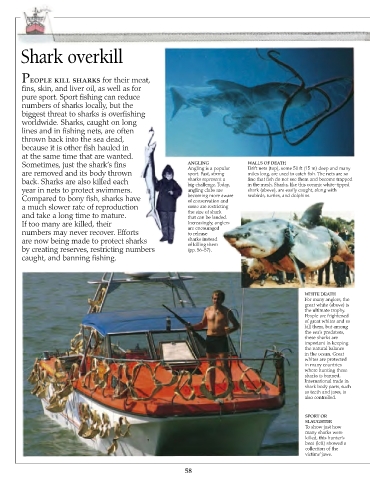
                                                                                   Drift nets (top), some 50 ft (15 m) deep and many
                                                               Angling is a popular
        are removed and its body thrown                        sport. Fast, strong   miles long, are used to catch fish. The nets are so
        back. Sharks are also killed each                      sharks represent a   fine that fish do not see them and become trapped
                                                                                   in the mesh. Sharks, like this oceanic white-tipped
                                                               big challenge. Today,
        year in nets to protect swimmers.                      angling clubs are   shark (above), are easily caught, along with
        Compared to bony fish, sharks have                     becoming more aware   seabirds, turtles, and dolphins.
                                                               of conservation and
        a much slower rate of reproduction                     some are restricting
        and take a long time to mature.                        the size of shark
                                                               that can be landed.
        If too many are killed, their                          Increasingly, anglers
        numbers may never recover. Efforts                     are encouraged
                                                               to release
        are now being made to protect sharks                   sharks instead
                                                               of killing them
        by creating reserves, restricting numbers              (pp. 56–57).
        caught, and banning fishing.


                                                                                                      White deAth
                                                                                                      For many anglers, the
                                                                                                      great white (above) is
                                                                                                      the ultimate trophy.
                                                                                                      People are frightened
                                                                                                      of great whites and so
                                                                                                      kill them, but among
                                                                                                      the sea’s predators,
                                                                                                      these sharks are
                                                                                                      important in keeping
                                                                                                      the natural balance
                                                                                                      in the ocean. Great
                                                                                                      whites are protected
                                                                                                      in many countries
                                                                                                      where hunting these
                                                                                                      sharks is banned.
                                                                                                      International trade in
                                                                                                      shark body parts, such
                                                                                                      as teeth and jaws, is
                                                                                                      also controlled.


                                                                                                      sport or
                                                                                                      slAughter
                                                                                                      To show just how
                                                                                                      many sharks were
                                                                                                      killed, this hunter’s
                                                                                                      boat (left) showed a
                                                                                                      collection of the
                                                                                                      victims’ jaws.

                                                              58

