


Page 53 - Shark
P. 53
chain waLL
                                                       This wall (left) of interlinked chains
                                                       surrounding an Australian beach
                                                       prevents any sharks from
                                                       getting in. Such walls are
                                                       too costly to protect more
                                                       than a few miles of beach.
                                                       Chemical repellants have
                                                       also been tried but they are
                                                       not effective, as any substance
                                                       released around a person in the
                                                       water disperses too quickly in
                                                       the waves.


                                                                                               invisibLe barrier
                                                                                                Sharks are very sensitive to
                                                                                                electric currents and here
                                                                                                 an invisible electric barrier
                                                                                                 is being tested. When the
                                                                                                 current is off (top) the
                                                                                                 lemon shark swims past,
                                                                                                 but when the current is
                                                                                                switched on (left) the shark
                       protected beach                                                         turns back to avoid it. Cables
         Experiments using screens made of bubbles released from air                          and even portable devices that
        hoses on the seabed have been carried out, but shark nets, as on                    produce electrical pulses to deter
       this Australian beach (above), still seem to offer the best protection.           sharks have been tested in the sea.


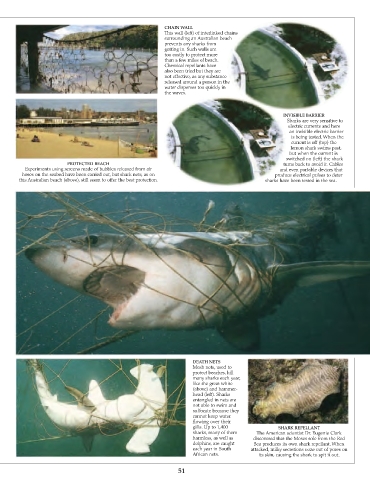
                                                                 death nets
                                                                 Mesh nets, used to
                                                                 protect beaches, kill
                                                                 many sharks each year,
                                                                 like the great white
                                                                 (above) and hammer-
                                                                 head (left). Sharks
                                                                 entangled in nets are
                                                                 not able to swim and
                                                                 suffocate because they
                                                                 cannot keep water
                                                                 flowing over their
                                                                 gills. Up to 1,400          sharK repeLLant
                                                                 sharks, many of them   The American scientist Dr. Eugenie Clark
                                                                 harmless, as well as   discovered that the Moses sole from the Red
                                                                 dolphins, are caught   Sea produces its own shark repellant. When
                                                                 each year in South   attacked, milky secretions ooze out of pores on
                                                                 African nets.         its skin, causing the shark to spit it out.

                                                            51

