


Page 58 - Shark
P. 58
Tagging sharks                                   Australian certificate (top),             Two Australian
                                                                                                   applicators
                                                         and card (bottom) for
                                                         details of captured shark
                                                                                                   with nylon
                                                                                                   and
                                                                                                   plastic
                                                                                                   tags
        Anglers can help scientists find out where sharks go and
        how fast they grow by measuring, tagging, and releasing
        them. Tens of thousands of sharks have been tagged since                                                 Return
        the 1950s, off the coasts of the US and Australia, as well                                               address
        as the UK and Africa. A few tags are recovered when                                          Tag        Metal tip
                                                                                                                  pierces
        fishermen catch these sharks again. The record is for a                                                shark’s skin
        male Australian tope, which was first tagged in 1951 and
        recaptured in 1986, 130 miles (214 km)
        from its original release site. Its length
        had increased by 7 in (17 cm). Blue sharks
        are among the greatest ocean travelers.
        One tagged near New York was caught
        16 months later off Brazil, 3,600 miles
        (6,000 km) away, while another tagged
        off the UK’s Devon coast was recaptured                                                Where blue sharks have been
                                                                                               tagged, released, and recaptured
        off Brazil, 4,200 miles (7,000 km) away.                                                      Cornwall, UK
                                                                                                      West Africa
                                                                                                      Eastern Seaboard, US


                                                                                                 0      600   1,200  1,800 miles

                                                     Bird ringing
                                                     Ringing bands around young birds’ legs gives information on
                                                     migration—just as tags do for sharks—if they are caught again.


                                                    Bait


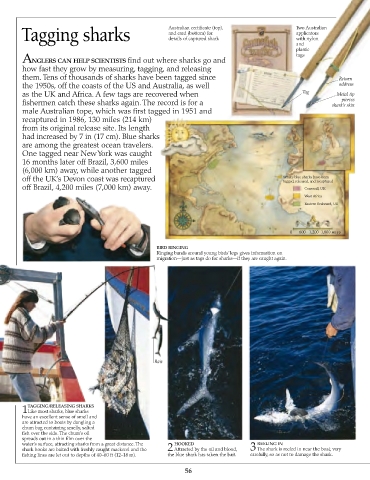
          Tagging/releasing sharks
        1Like most sharks, blue sharks
        have an excellent sense of smell and
        are attracted to boats by dangling a
        chum bag containing smelly, salted
        fish over the side. The chum’s oil
        spreads out in a thin film over the
        water’s surface, attracting sharks from a great distance. The                      hooked   reeling in
        shark hooks are baited with freshly caught mackerel and the   2 Attracted by the oil and blood,  3 The shark is reeled in near the boat, very

        fishing lines are let out to depths of 40–60 ft (12–18 m).  the blue shark has taken the bait.  carefully, so as not to damage the shark.
                                                              56

