


Page 269 - Portuguese Dictionary Phrasebook (The Rough Guide)
P. 269
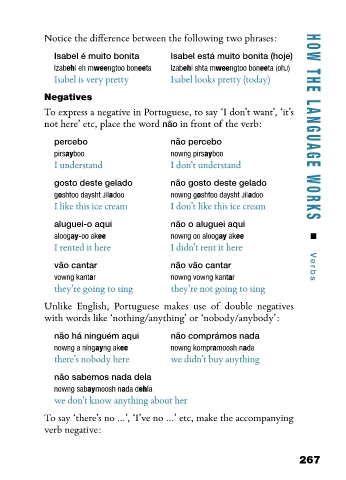
Notice the difference between the following two phrases:
                 Isabel é muito bonita  Isabel está muito bonita (hoje)
                 Izabehl eh mweengtoo boneeta  Izabehl shta mweengtoo boneeta (ohJ)
                 Isabel is very pretty  Isabel looks pretty (today)
               Negatives
               To express a negative in Portuguese, to say ‘I don’t want’, ‘it’s
               not here’ etc, place the word não in front of the verb:  HOW THE LANGUAGE WORKS
                 percebo             não percebo
                 pirsayboo           nowng pirsayboo
                 I understand        I don’t understand
                 gosto deste gelado  não gosto deste gelado
                 goshtoo daysht Jiladoo  nowng goshtoo daysht Jiladoo
                 I like this ice cream  I don’t like this ice cream
                 aluguei-o aqui      não o aluguei aqui
                 aloogay-oo akee     nowng oo aloogay akee   N
                 I rented it here    I didn’t rent it here
                 vão cantar          não vão cantar          Verbs
                 vowng kantar        nowng vowng kantar
                 they’re going to sing  they’re not going to sing
               Unlike English, Portuguese makes use of double negatives
               with words like ‘nothing/anything’ or ‘nobody/anybody’:
                 não há ninguém aqui  não comprámos nada
                 nowng a ningayng akee  nowng kompramoosh nada
                 there’s nobody here  we didn’t buy anything
                 não sabemos nada dela
                 nowng sabaymoosh nada dehla
                 we don’t know anything about her
               To say ‘there’s no ...’, ‘I’ve no ...’ etc, make the accompanying
               verb negative:

                                                           267


 RG New PORTUGUESE How the Langua267   267a267 26677

