


Page 266 - Portuguese Dictionary Phrasebook (The Rough Guide)
P. 266
Use of the Past Participle
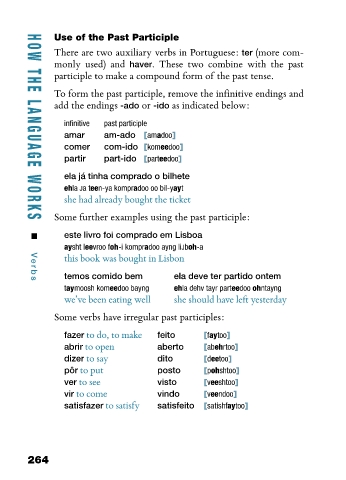
                 There are two auxiliary verbs in Portuguese: ter (more comr  -
                 monly used) and haver. These two combine with the  past
                 participle to make a compound form of the past tense.
                 To form the past participle, remove the infinitive endings and
                 add the endings -ado or -ido as indicated below:
                   infinitive  past participle
                   amar   am-ado  [amadoo]
                   comer  com-ido [komeedoo]
                   partir   part-ido [parteedoo]
                   ela já tinha comprado o bilhete
                   ehla Ja teen-ya kompradoo oo bil-yayt
                   she had already bought the ticket
                 Some further examples using the past participle:
             HOW THE LANGUAGE WORKS
                   este livro foi comprado em Lisboa
                   aysht leevroo foh-i kompradoo ayng liJboh-a
             N
                   this book was bought in Lisbon
                   temos comido bem   ela deve ter partido ontem
             Verbs
                   taymoosh komeedoo bayng  ehla dehv tayr parteedoo ohntayng
                   we’ve been eating well  she should have left yesterday
                 Some verbs have irregular past participles:
                   fazer to do, to make  feito  [faytoo]
                   abrirr to open  aberto  [abehrtoo]
                   dizer to say    dito    [deetoo]
                   pôr to put      posto   [pohshtoo]
                   ver to see      visto   [veeshtoo]
                   vir to come     vindo   [veendoo]
                   satisfazerr to satisfy   satisfeito  [satishfaytoo]


             264


 RG New PORTUGUESE How the Langua264   26464 264644

