


Page 25 - BBC Wildlife Volume 36 #06
P. 25
WATER VOLES
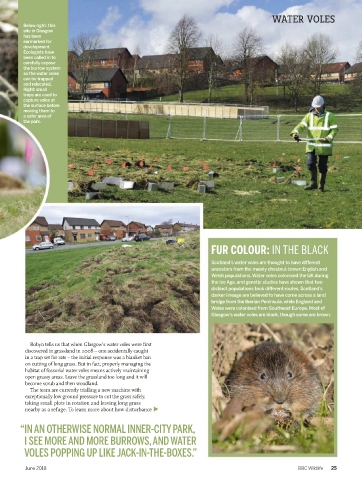
         Below right: this
         site in Glasgow
         has been
         earmarked for
         development.
         Ecologists have
         been called in to
         carefully expose
         the burrow system
         so the water voles
         can be trapped
         and relocated.
         Right: small
         traps are used to
         capture voles at
         the surface before
         moving them to
         a safer area of
         the park.


                                                                         FUR COLOUR: IN THE BLACK

                                                                         Scotland’s water voles are thought to have different
                                                                         ancestors from the mainly chestnut-brown English and
                                                                         Welsh populations. Water voles colonised the UK during
                                                                         the Ice Age, and genetic studies have shown that two
                                                                         distinct populations took different routes. Scotland’s
                                                                         darker lineage are believed to have come across a land
                                                                         bridge from the Iberian Peninsula, while England and
                                                                         Wales were colonised from Southeast Europe. Most of
                                                                         Glasgow’s water voles are black, though some are brown.


           Robyn tells us that when Glasgow’s water voles were first
          discovered in grassland in 2008 – one accidentally caught
          in a trap set for rats – the initial response was a blanket ban
          on cutting of long grass. But in fact, properly managing the
          habitat of fossorial water voles means actively maintaining
          open grassy areas. Leave the grassland too long and it will
          become scrub and then woodland.
           The team are currently trialling a new machine with
          exceptionally low ground pressure to cut the grass safely,
          taking small plots in rotation and leaving long grass
          nearby as a refuge. To learn more about how disturbance


        “ IN AN OTHERWISE NORMAL INNER-CITY PARK,
         I SEE MORE AND MORE BURROWS, AND WATER

         VOLES POPPING UP LIKE JACK-IN-THE-BOXES.”

          June 2018                                                                                   BBC Wildlife  25

