


Page 26 - BBC Wildlife Volume 36 #06
P. 26
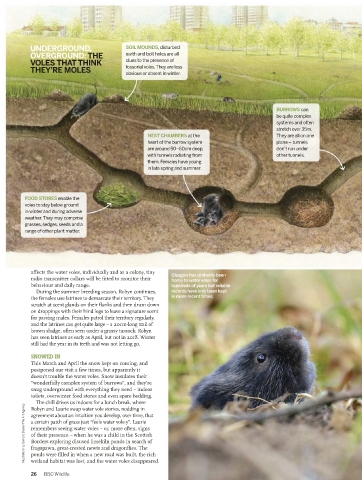
UNDERGROUND,                     SOIL MOUNDS, disturbed
           OVERGROUND: THE                  earth and bolt holes are all
           VOLES THAT THINK                 clues to the presence of
           THEY’RE MOLES                    fossorial voles. They are less
                                            obvious or absent in winter.


                                                                                               BURROWS can
                                                                                               be quite complex
                                                                                               systems and often
                                                                                               stretch over 35m.
                                                   NEST CHAMBERS at the                        They are all on one
                                                   heart of the burrow system                  plane – tunnels
                                                   are around 50–60cm deep,                    don’t run under
                                                   with tunnels radiating from                 other tunnels.
                                                   them. Females have young
                                                   in late spring and summer.


         FOOD STORES enable the
         voles to stay below ground
         in winter and during adverse
         weather. They may comprise
         grasses, sedges, seeds and a
         range of other plant matter.


            affects the water voles, individually and as a colony, tiny
                                                           Glasgow has probably been
            radio transmitter collars will be fitted to monitor their   home to water voles for
            behaviour and daily range.                     hundreds of years but reliable
             During the summer breeding season, Robyn continues,   records have only been kept
            the females use latrines to demarcate their territory. They   in more recent times.
            scratch at scent glands on their flanks and then drum down
            on droppings with their hind legs to leave a signature scent
            for passing males. Females patrol their territory regularly,
            and the latrines can get quite large – a 20cm-long trail of
            brown sludge, often seen under a grassy tussock. Robyn
            has seen latrines as early as April, but not in 2018. Winter
            still had the year in its teeth and was not letting go.

            SNOWED IN
            This March and April the snow kept on coming, and
            postponed our visit a few times, but apparently it
            doesn’t trouble the water voles. Snow insulates their
            “wonderfully complex system of burrows”, and they’re
            snug underground with everything they need – indoor
            toilets, overwinter food stores and even spare bedding.
             The chill drives us indoors for a lunch break, where
         Illustration by Sandra Doyle/The Art Agency  a certain patch of grass just “feels water vole-y”. Laurie
            Robyn and Laurie swap water vole stories, nodding in
            agreement about an intuition you develop, over time, that

            remembers seeing water voles – or, more often, signs
            of their presence – when he was a child in the Scottish
            Borders exploring disused limekiln ponds in search of
            frogspawn, great-crested newts and dragonflies. The
            ponds were filled in when a new road was built, the rich
            wetland habitat was lost, and the water voles disappeared.

            26  BBC Wildlife

