


Page 17 - Dinosaur (DK Eyewitness Books)
P. 17
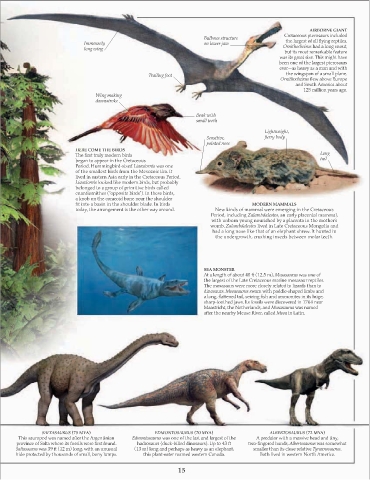
AIRBORNE GIANT
                                                                                               Cretaceous pterosaurs included
                                                                     Bulbous structure
                             Immensely                               on lower jaw              the largest of all flying reptiles.
                             long wing                                                         Ornithocheirus had a long snout,
                                                                                               but its most remarkable feature
                                                                                              was its great size. This might have
                                                                                             been one of the largest pterosaurs
                                                                                             ever—as heavy as a man and with
                                                  Trailing foot                                 the wingspan of a small plane.
                                                                                              Ornithocheirus flew above Europe
                                                                                                   and South America about
                                                                                                     125 million years ago.
                                 Wing making
                                 downstroke

                                                                  Beak with
                                                                  small teeth

                                                                                         Lightweight,
                                                                     Sensitive,          furry body
                                                                     pointed nose
                          HERE COME THE BIRDS
                          The first truly modern birds                                                     Long
                                                                                                           tail
                          began to appear in the Cretaceous
                          Period. Hummingbird-sized Liaoxiornis was one
                          of the smallest birds from the Mesozoic Era. It
                          lived in eastern Asia early in the Cretaceous Period.
                          Liaoxiornis looked like modern birds, but probably
                          belonged to a group of primitive birds called
                          enantiornithes (“opposite birds”). In these birds,
                          a knob on the coracoid bone near the shoulder
                          fit into a basin in the shoulder blade. In birds          MODERN MAMMALS
                          today, the arrangement is the other way around.  New kinds of mammal were emerging in the Cretaceous
                                                                       Period, including Zalambdalestes, an early placental mammal,
                                                                       with unborn young nourished by a placenta in the mother’s
                                                                       womb. Zalambdalestes lived in Late Cretaceous Mongolia and
                                                                       had a long nose like that of an elephant shrew. It hunted in
                                                                        the undergrowth, crushing insects between molar teeth.


                                                                    SEA MONSTER
                                                                    At a length of about 40 ft (12.5 m), Mosasaurus was one of
                                                                    the largest of the Late Cretaceous marine mosasaur reptiles.
                                                                    The mosasaurs were more closely related to lizards than to
                                                                    dinosaurs. Mosasaurus swam with paddle-shaped limbs and
                                                                    a long, flattened tail, seizing fish and ammonites in its huge,
                                                                    sharp-toothed jaws. Its fossils were discovered in 1764 near
                                                                    Maastricht, the Netherlands, and Mosasaurus was named
                                                                    after the nearby Meuse River, called Mosa in Latin.


               SALTASAURUS (75 MYA)                 EDMONTOSAURUS (70 MYA)                ALBERTOSAURUS (72 MYA)
       This sauropod was named after the Argentinian   Edmontosaurus was one of the last and largest of the   A predator with a massive head and tiny,
      province of Salta where its fossils were first found.   hadrosaurs (duck-billed dinosaurs). Up to 43 ft    two-fingered hands, Albertosaurus was somewhat
      Saltasaurus was 39 ft (12 m) long, with an unusual   (13 m) long and perhaps as heavy as an elephant,    smaller than its close relative Tyrannosaurus.
      hide protected by thousands of small, bony lumps.  this plant-eater roamed western Canada.  Both lived in western North America.

                                                            15

