


Page 19 - Dinosaur (DK Eyewitness Books)
P. 19
Impact crater in Mexico's   Iridium layer
                                             Yucatán peninsula
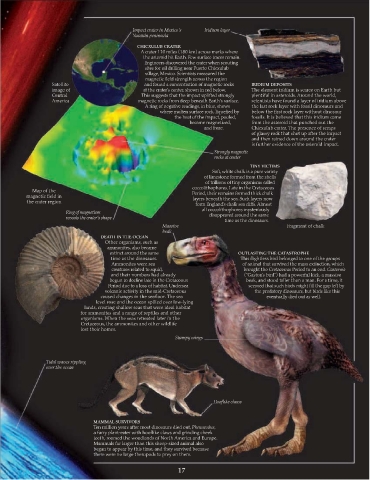
                                              CHICXULUB CRATER
                                                A crater 110 miles (180 km) across marks where
                                                the asteroid hit Earth. Few surface traces remain.
                                                 Engineers discovered the crater when scouting
                                                 sites for oil drilling near Puerto Chicxulub
                                                 village, Mexico. Scientists measured the
                                                 magnetic field strength across the region
                  Satellite                      and found a concentration of magnetic rocks    IRIDIUM DEPOSITS
                  image of                      at the crater's center, shown in red below.    The element iridium is scarce on Earth but
                  Central                       This suggests that the impact uplifted strongly   plentiful in asteroids. Around the world,
                  America                      magnetic rocks from deep beneath Earth's surface.   scientists have found a layer of iridium above
                                                 A ring of negative readings, in blue, shows   the last rock layer with fossil dinosaurs and
                                                      where molten surface rock, liquefied by   below the first rock layer without dinosaur
                                                           the heat of the impact, pooled,   fossils. It is believed that this iridium came
                                                                became magnetized,    from the asteroid that punched out the
                                                                     and froze.     Chicxulub crater. The presence of scraps
                                                                                    of glassy rock that shot up after the impact
                                                                                    and then rained down around the crater
                                                                                    is further evidence of the asteroid impact.
                                                                        Strongly magnetic
                                                                        rocks at center
                                                                                    TINY VICTIMS
                                                                       Soft, white chalk is a pure variety
                                                                     of limestone formed from the shells
                                                                     of trillions of tiny organisms called
                                                                 coccolithophores. Late in the Cretaceous
            Map of the                                           Period, their remains formed thick chalk
          magnetic field in                                      layers beneath the sea. Such layers now
          the crater region
                                                                  form England’s chalk sea cliffs. Almost
                                                                    all coccolithophores mysteriously
                       Ring of magnetism                              disappeared around the same
                       reveals the crater's shape
                                                                           time as the dinosaurs.
                                                       Massive                                  Fragment of chalk
                                                       beak
                                  DEATH IN THE OCEAN
                                    Other organisms, such as
                                     ammonites, also became
                                     extinct around the same                    OUTLASTING THE CATASTROPHE
                                      time as the dinosaurs.                     This flightless bird belonged to one of the groups
                                      Ammonites were sea                         of animal that survived the mass extinction, which
                                      creatures related to squid,                 brought the Cretaceous Period to an end. Gastornis
                                      and their numbers had already               (“Gaston’s bird”) had a powerful kick, a massive
                                     begun to decline late in the Cretaceous      beak, and stood taller than a man. For a time, it
                                     Period due to a loss of habitat. Undersea     seemed that such birds might fill the gap left by
                                    volcanic activity in the mid-Cretaceous          the predatory dinosaurs, but birds like this
                                  caused changes in the seafloor. The sea                eventually died out as well.
                                 level rose and the ocean spilled over low-lying
                             lands, creating shallow seas that were ideal habitat
                            for ammonites and a range of reptiles and other
                            organisms. When the seas retreated later in the
                            Cretaceous, the ammonites and other wildlife
                            lost their homes.
                                                           Stumpy wings


                Tidal waves rippling
                over the ocean


                                                                        Hooflike claws


                                MAMMAL SURVIVORS
                                Ten million years after most dinosaurs died out, Phenacodus,
                                a furry plant-eater with hooflike claws and grinding cheek
                                teeth, roamed the woodlands of North America and Europe.
                                Mammals far larger than this sheep-sized animal also
                                began to appear by this time, and they survived because
                                there were no large theropods to prey on them.

                                                            17

