


Page 16 - Dinosaur (DK Eyewitness Books)
P. 16
Europe          Cretaceous times
            North
            America          Asia
             West          Tethys
            Africa          Sea     TȩȦ ȤȳȦȵȢȤȦȰȶȴ ȱȦȳȪȰȥ lasted from 145 to
                  Africa  India
                                    65 million years ago and closed the Mesozoic Era,
          South
         America                    marking the climax of the Age of Dinosaurs.
                                    Climates remained warm or mild, but great
                          Australia
                                    changes happened to our planet. Flowering
                    Antarctica
                                    plants began to replace older kinds, seas
        THE CRETACEOUS WORLD        flooded low-lying lands, and continents
        In the Cretaceous Period, the   split up and moved apart. As the
        supercontinents Laurasia and
        Gondwana broke up completely.   landmasses separated, the dinosaurs
        Their fragments gradually took    that became cut off from one
        on the shapes of the continents
        we know today. By the end of this   another adapted to different
        period, most had drifted close to
        their present positions, but India   environments. In the late
        had not yet docked with Asia. For    Cretaceous Period, there
        a while, shallow seas overflowed
        stretches of low-lying land.  were probably more kinds
                                    of dinosaur than ever before.


                                                         Upper part of trunk
                                                         covered with leaves


                                       FROM FOLIAGE TO FLOWERS
                                         Early in the Cretaceous Period, plants such
                                          as conifers, cycads, and ferns still covered
                                            the land. A strange tree-fern called
                                           Tempskya was widespread in the northern
                                             continents. It had a false trunk made of
                                              stems surrounded by roots, with leaves
                                                that grew outward. Angiosperms, or
                                              flowering plants, appeared for the first time.
                                           They began to grow on open ground and spread
                                         out from the tropics, changing landscapes forever.
                                       Most early kinds of angiosperm were probably small
                                     and weedy, but some gave rise to shrubs and small trees.
                       Magnolia        By the end of the Cretaceous Period, magnolias and
                        flower         other flowering trees had formed extensive forests.


                                                          Tempskya tree-fern forest
        AN AGE OF DIVERSITY
        Cretaceous dinosaurs included some of the most massive
        sauropods and theropods of all time. Theropods now also
        included an amazing variety of feathered birds and birdlike
        dinosaurs—some smaller than a sparrow, and others as
        large as an elephant. Stegosaurs had vanished, but the
        horned dinosaurs appeared, as did the largest ankylosaurs
        and ornithopods.


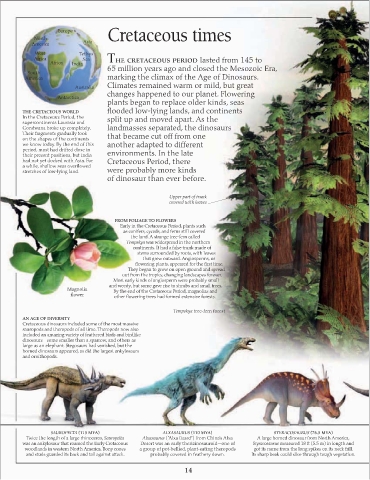
                  SAUROPELTA (115 MYA)                 ALXASAURUS (110 MYA)                 STYRACOSAURUS (76.5 MYA)
          Twice the length of a large rhinoceros, Sauropelta  Alxasaurus (“Alxa lizard”) from China’s Alxa   A large horned dinosaur from North America,
        was an ankylosaur that roamed the Early Cretaceous   Desert was an early therizinosauroid—one of    Styracosaurus measured 18 ft (5.5 m) in length and
         woodlands in western North America. Bony cones   a group of pot-bellied, plant-eating theropods   got its name from the long spikes on its neck frill.
          and studs guarded its back and tail against attack.  probably covered in feathery down.  Its sharp beak could slice through tough vegetation.

                                                              14

