


Page 21 - Dinosaur (DK Eyewitness Books)
P. 21
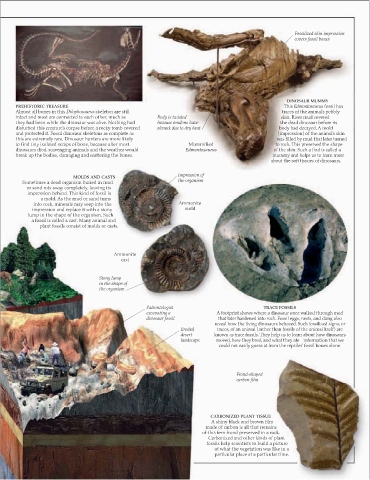
Fossilized skin impression
                                                                                                   covers fossil bones


                                                                                                DINOSAUR MUMMY
      PREHISTORIC TREASURE                                                                     This Edmontosaurus fossil has
      Almost all bones in this Dilophosaurus skeleton are still                               traces of the animal’s pebbly
      intact and most are connected to each other, much as    Body is twisted                 skin. River mud covered
      they had been while the dinosaur was alive. Nothing had   because tendons have          the dead dinosaur before its
      disturbed this creature’s corpse before a rocky tomb covered   shrunk due to dry heat  body had decayed. A mold
      and protected it. Fossil dinosaur skeletons as complete as                             (impression) of the animal’s skin
      this are extremely rare. Dinosaur hunters are more likely                              was filled by mud that later turned
      to find tiny isolated scraps of bone, because after most   Mummified                  to rock. This preserved the shape
      dinosaurs died, scavenging animals and the weather would   Edmontosaurus              of the skin. Such a find is called a
      break up the bodies, damaging and scattering the bones.                              mummy and helps us to learn more
                                                                                           about the soft tissues of dinosaurs.

                                                            Impression of
                         MOLDS AND CASTS
                                                            the organism
        Sometimes a dead organism buried in mud
          or sand rots away completely, leaving its
          impression behind. This kind of fossil is
              a mold. As the mud or sand turns
            into rock, minerals may seep into the           Ammonite
            impression and replace it with a stony            mold
          lump in the shape of the organism. Such
           a fossil is called a cast. Many animal and
              plant fossils consist of molds or casts.


                                       Ammonite
                                         cast


                                  Stony lump
                                  in the shape of
                                  the organism


                                                 Paleontologist                         TRACE FOSSILS
                                                 excavating a            A footprint shows where a dinosaur once walked through mud
                                                 dinosaur fossil         that later hardened into rock. Fossil eggs, nests, and dung also
                                                                        reveal how the living dinosaurs behaved. Such fossilized signs, or
                                                             Eroded      traces, of an animal (rather than fossils of the animal itself) are
                                                             desert     known as trace fossils. They help us to learn about how dinosaurs
                                                             landscape  moved, how they bred, and what they ate—information that we
                                                                         could not easily guess at from the reptiles’ fossil bones alone.


                                                                               Frond-shaped
                                                                               carbon film


                                                                       CARBONIZED PLANT TISSUE
                                                                       A shiny black and brown film
                                                                     made of carbon is all that remains
                                                                    of this fern frond preserved in a rock.
                                                                      Carbonized and other kinds of plant
                                                                     fossils help scientists to build a picture
                                                                        of what the vegetation was like in a
                                                                        particular place at a particular time.

