


Page 20 - Dinosaur (DK Eyewitness Books)
P. 20
Limestone  How do we know?


                     WȦ ȬȯȰȸ ȸȩȢȵ ȭȰȯȨ ȥȦȢȥ ȥȪȯȰȴȢȶȳȴ were like because
                     paleontologists have dug up their remains. Most of these
                     belonged to corpses buried under mud, sand, or volcanic ash that
                     slowly hardened into rock. Minerals filled pores (spaces) in the
                     bones and hardened them, or replaced them altogether, turning
                     bone to stone, in a process called permineralization. All that is left    DIGGING UP THE PAST
                                                                                               Paleontologist Luis Chiappe
                     are usually fossilized bones that have been buried in the ground
                  Sandstone  for millions of years. Sometimes, though, the shapes of a body’s   at Ukhaa Tolgod in Mongolia’s
                                                                                               excavates a Protoceratops skull
                                                                                               Gobi Desert. Determined
                                                       soft parts—skin, tendons, and
                                                                                               dinosaur hunters sometimes
                                                        muscles—have survived,                 travel halfway around the world to
                                                                                               reach the best bone beds. There
                                                         giving scientists precious,           they must often camp and work
                                                        rare glimpses of soft anatomy.         in harsh conditions and put up
                                                                                               with scorching heat or bitter cold.
                                                              Dinosaur at
                                                              riverbank                   Bones of recently
                  Shale                                                                   deceased
                                                                                          dinosaurs


                                                                                                                Layers
                  Volcanic ash                                                                                  up on top
                                                                                                                building


                  Limestone


                  Volcanic ash


                           Stack of
                           layered rocks


                                             Dry riverbed
                  Shale  ROCK LAYERS                                    Dinosaur
                     Fossils occur in sedimentary rocks. These are formed
                     when sediment (sand, mud, and gravel) builds up in   fossil in rock
                     layers and is compressed over many million years. A
                     series of sedimentary layers can be exposed in a cliff
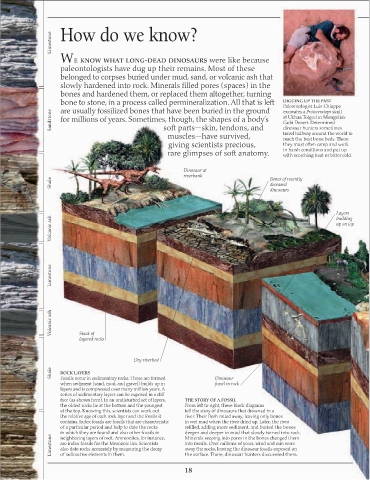
                     face (as shown here). In an undisturbed set of layers,   THE STORY OF A FOSSIL
                     the oldest rocks lie at the bottom and the youngest    From left to right, these block diagrams
                     at the top. Knowing this, scientists can work out    tell the story of dinosaurs that drowned in a
                     the relative age of each rock layer and the fossils it   river. Their flesh rotted away, leaving only bones
                     contains. Index fossils are fossils that are characteristic   in wet mud when the river dried up. Later, the river
                     of a particular period and help to date the rocks    refilled, adding more sediment, and buried the bones
                     in which they are found and also other fossils in   deeper and deeper in mud that slowly turned into rock.
                  Limestone  are index fossils for the Mesozoic Era. Scientists    into fossils. Over millions of years, wind and rain wore
                                                              Minerals seeping into pores in the bones changed them
                     neighboring layers of rock. Ammonites, for instance,
                     also date rocks accurately by measuring the decay
                                                              away the rocks, leaving the dinosaur fossils exposed on
                                                              the surface. There, dinosaur hunters discovered them.
                     of radioactive elements in them.
                                                              18

