


Page 54 - Dinosaur (DK Eyewitness Books)
P. 54
Ancient footprints


        A ȥȪȯȰȴȢȶȳ ȸȢȭȬȪȯȨ by a river, lake, or sea
         sometimes left its footprints in soft mud that quickly
         dried and hardened. Buried by successive layers
         of mud, this slowly turned to rock, preserving the
         footprints inside it as fossils. The shapes and sizes
         of such prints and the gaps between them can help
         scientists to identify different types of track-makers,
         and also work out the sizes of the dinosaurs and
         how fast they walked or ran. Scientists can even
         tell where a dinosaur hunted, or where a herd
         trekked together. People find fossil dinosaur
         tracks all over the world. They give us glimpses
         of dinosaurs’ lives that we could never get by
         just studying their bones.


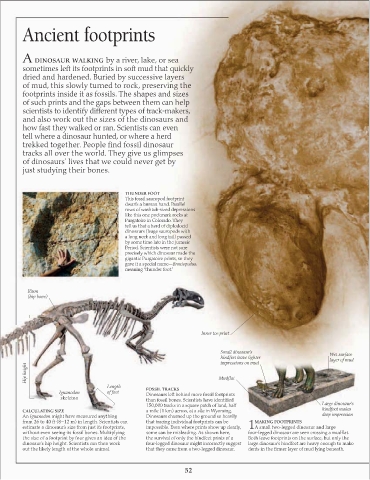
                                          THUNDER FOOT
                                          This fossil sauropod footprint
                                          dwarfs a human hand. Parallel
                                          rows of washtub-sized depressions
                                          like this one pockmark rocks at
                                          Purgatoire in Colorado. They
                                          tell us that a herd of diplodocid
                                          dinosaurs (huge sauropods with
                                          a long neck and long tail) passed
                                          by some time late in the Jurassic
                                          Period. Scientists were not sure
                                          precisely which dinosaur made the
                                          gigantic Purgatoire prints, so they
                                          gave it a special name—Brontopodus,
                                          meaning “thunder foot.”


          Ilium
          (hip bone)


                                                                    Inner toe print


                                                                          Small dinosaur’s
                                                                                                              Wet surface
                                                                          hindfeet leave lighter
                                                                                                              layer of mud
                                                                          impressions on mud
          Hip height                                                     Mudflat
                                    Length
                                                 FOSSIL TRACKS
                     Iguanodon      of foot      Dinosaurs left behind more fossil footprints
                     skeleton
                                                 than fossil bones. Scientists have identified
                                                                                                            Large dinosaur’s
                                                 150,000 tracks in a square patch of land, half
                                                                                                            hindfoot makes
        CALCULATING SIZE                         a mile (1 km) across, at a site in Wyoming.
                                                                                                            deep impression
        An Iguanodon might have measured anything   Dinosaurs churned up the ground so heavily
        from 26 to 40 ft (8–12 m) in length. Scientists can   that tracing individual footprints can be   MAKING FOOTPRINTS
        estimate a dinosaur’s size from just its footprints,   impossible. Even where prints show up clearly,   1A small two-legged dinosaur and large
        without even seeing its fossil bones. Multiplying    some can be misleading. As shown here,    four-legged dinosaur are seen crossing a mudflat.
        the size of a footprint by four gives an idea of the   the survival of only the hindfeet prints of a   Both leave footprints on the surface, but only the
        dinosaur’s hip height. Scientists can then work    four-legged dinosaur might incorrectly suggest   large dinosaur’s hindfeet are heavy enough to make
        out the likely length of the whole animal.  that they came from a two-legged dinosaur.  dents in the firmer layer of mud lying beneath.
                                                              52

