


Page 50 - Dinosaur (DK Eyewitness Books)
P. 50
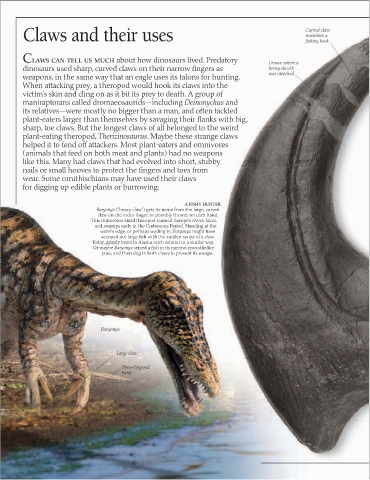
Claws and their uses                                                                          Curved claw
                                                                                                      resembles a
                                                                                                      fishing hook


        CȭȢȸȴ ȤȢȯ ȵȦȭȭ ȶȴ ȮȶȤȩ about how dinosaurs lived. Predatory                       Groove where a
         dinosaurs used sharp, curved claws on their narrow fingers as                    horny sheath
                                                                                          was attached
         weapons, in the same way that an eagle uses its talons for hunting.
         When attacking prey, a theropod would hook its claws into the
         victim’s skin and cling on as it bit its prey to death. A group of
         maniraptorans called dromaeosaurids—including Deinonychus and
         its relatives—were mostly no bigger than a man, and often tackled
         plant-eaters larger than themselves by savaging their flanks with big,
         sharp, toe claws. But the longest claws of all belonged to the weird
         plant-eating theropod, Therizinosaurus. Maybe these strange claws
         helped it to fend off attackers. Most plant-eaters and omnivores
         (animals that feed on both meat and plants) had no weapons
         like this. Many had claws that had evolved into short, stubby
         nails or small hooves to protect the fingers and toes from
         wear. Some ornithischians may have used their claws
         for digging up edible plants or burrowing.


                                                              A FISHY HUNTER
                                 Baryonyx (“heavy claw”) gets its name from the large, curved
                                 claw on the index finger, or possibly thumb, on each hand.
                               This rhinoceros-sized theropod roamed Europe’s rivers, lakes,
                                and swamps early in the Cretaceous Period. Standing at the
                                  water’s edge, or perhaps wading in, Baryonyx might have
                                   scooped out large fish with the sudden swipe of a claw.
                               Today, grizzly bears in Alaska catch salmon in a similar way.
                                Or maybe Baryonyx seized a fish in its narrow, crocodilelike
                                   jaws, and then dug in both claws to prevent its escape.


                                  Baryonyx


                                        Large claw

                                         Three-fingered
                                         hand

