


Page 52 - Dinosaur (DK Eyewitness Books)
P. 52
Legs and feet


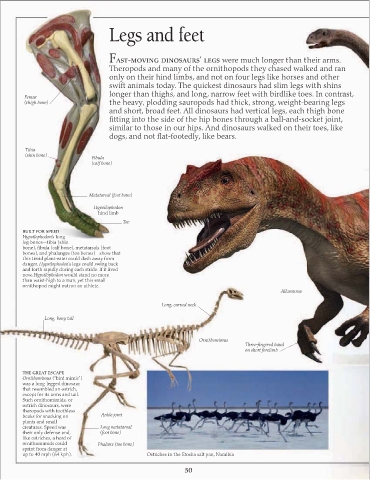
                                     FȢȴȵ ȮȰȷȪȯȨ ȥȪȯȰȴȢȶȳȴp ȭȦȨȴ were much longer than their arms.
                                     Theropods and many of the ornithopods they chased walked and ran
                                     only on their hind limbs, and not on four legs like horses and other
                                     swift animals today. The quickest dinosaurs had slim legs with shins
                                     longer than thighs, and long, narrow feet with birdlike toes. In contrast,
         Femur
         (thigh bone)                the heavy, plodding sauropods had thick, strong, weight-bearing legs
                                     and short, broad feet. All dinosaurs had vertical legs, each thigh bone
                                     fitting into the side of the hip bones through a ball-and-socket joint,
                                     similar to those in our hips. And dinosaurs walked on their toes, like
                                     dogs, and not flat-footedly, like bears.
         Tibia
         (shin bone)
                               Fibula
                               (calf bone)


                               Metatarsal (foot bone)
                                Hypsilophodon
                                 hind limb
                                          Toe
        BUILT FOR SPEED
        Hypsilophodon’s long
        leg bones—tibia (shin
        bone), fibula (calf bone), metatarsals (foot
        bones), and phalanges (toe bones)—show that
        this timid plant-eater could dash away from
        danger. Hypsilophodon’s legs could swing back
        and forth rapidly during each stride. If it lived
        now, Hypsilophodon would stand no more
        than waist-high to a man, yet this small
        ornithopod might outrun an athlete.
                                                                                              Allosaurus
                                                       Long, curved neck

                Long, bony tail


                                                                   Ornithomimus
                                                                                  Three-fingered hand
                                                                                  on short forelimb


        THE GREAT ESCAPE
        Ornithomimus (“bird mimic”)
        was a long-legged dinosaur
        that resembled an ostrich,
        except for its arms and tail.
        Such ornithomimids, or
        ostrich dinosaurs, were
        theropods with toothless
        beaks for snacking on     Ankle joint
        plants and small
        creatures. Speed was      Long metatarsal
        their only defense and,   (foot bone)
        like ostriches, a herd of
        ornithomimids could      Phalanx (toe bone)
        sprint from danger at
        up to 40 mph (64 kph).                    Ostriches in the Etosha salt pan, Namibia

                                                              50

