


Page 49 - Dinosaur (DK Eyewitness Books)
P. 49
Radius
                                                                        (forearm bone)            Radius

                                                                            Ulna
                                                                                                    Ulna
                                                                            (forearm
                                                                            bone)


                                                                                              Compact
           Fine, downy                                                                        wrist joint
           feathers may have
           covered the skin
                                                                          Wrist               Phalanx

                                                                 Phalanx
                                                                 (finger bone)


                                                                             Elephant forelimb    Camarasaurus forelimb
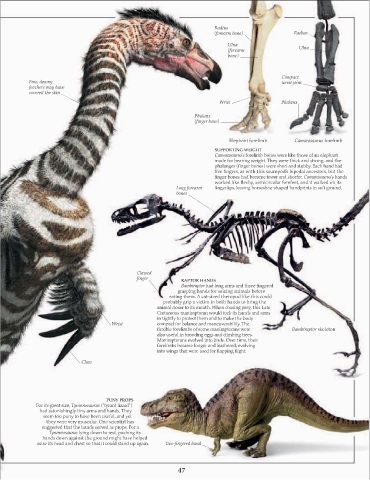
                                                                        SUPPORTING WEIGHT
                                                                        Camarasaurus’s forelimb bones were like those of an elephant—
                                                                        made for bearing weight. They were thick and strong, and the
                                                                        phalanges (finger bones) were short and stubby. Each hand had
                                                                        five fingers, as with this sauropod’s bipedal ancestors, but the
                                                                        finger bones had become fewer and shorter. Camarasaurus’s hands
                                                                        worked like fleshy, semicircular forefeet, and it walked on its
                                                           Long forearm   fingertips, leaving horseshoe-shaped handprints in soft ground.
                                                           bones


                                              Clawed
                                              finger
                                                             RAPTOR HANDS
                                                             Bambiraptor had long arms and three-fingered
                                                            grasping hands for seizing animals before
                                                         eating them. A cat-sized theropod like this could
                                                       probably grip a victim in both hands to bring the
                                                     animal closer to its mouth. When chasing prey, this Late
                                                     Cretaceous maniraptoran would tuck its hands and arms
                                                     in tightly to protect them and to make the body
                                      Wrist          compact for balance and maneuverability. The
                                                     flexible forelimbs of some maniraptorans were   Bambiraptor skeleton
                                                     also useful in brooding eggs and climbing trees.
                                                     Maniraptorans evolved into birds. Over time, their
                                                     forelimbs became longer and feathered, evolving
                                                     into wings that were used for flapping flight.
                            Claw


                                    PUNY PROPS
             For its great size, Tyrannosaurus (“tyrant lizard”)
              had astonishingly tiny arms and hands. They
               seem too puny to have been useful, and yet
                they were very muscular. One scientist has
               suggested that the hands served as props. For a
                 Tyrannosaurus lying down to rest, pushing its
               hands down against the ground might have helped
             raise its head and chest so that it could stand up again.  Two-fingered hand


                                                            47

