


Page 53 - Dinosaur (DK Eyewitness Books)
P. 53
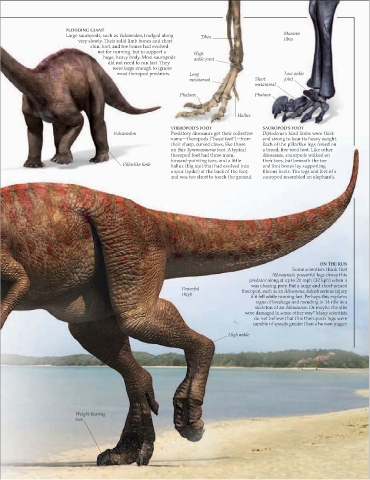
PLODDING GIANT
                       Large sauropods, such as Vulcanodon, trudged along   Tibia              Massive
                           very slowly. Their solid limb bones and short                       tibia
                               shin, foot, and toe bones had evolved
                                 not for running, but to support a   High
                                   huge, heavy body. Most sauropods   ankle joint
                                     did not need to run fast. They
                                      were large enough to ignore
                                        most theropod predators.  Long                         Low ankle
                                                                metatarsal           Short     joint
                                                                                     metatarsal
                                                             Phalanx                 Phalanx


                                                                                Hallux

                                                         THEROPOD’S FOOT                SAUROPOD’S FOOT
                                       Vulcanodon        Predatory dinosaurs get their collective   Diplodocus‘s hind limbs were thick
                                                         name—theropods (“beast feet”)—from   and strong to bear its heavy weight.
                                                         their sharp, curved claws, like those    Each of the pillarlike legs rested on
                                                         on this Tyrannosaurus foot. A typical   a broad, five-toed foot. Like other
                                                         theropod foot had three main,    dinosaurs, sauropods walked on
                                                         forward-pointing toes, and a little   their toes, but beneath the toe
                                          Pillarlike limb  hallux (big toe) that had evolved into    and foot bones lay supporting
                                                         a spur (spike) at the back of the foot,   fibrous heels. The legs and feet of a
                                                         and was too short to touch the ground.  sauropod resembled an elephant’s.


                                                                                                           ON THE RUN
                                                                                                  Some scientists think that
                                                                                           Allosaurus’s powerful legs drove this
                                                                                    predator along at up to 20 mph (32 kph) when it
                                                                                    was chasing prey. But a large and short-armed
                                                             Powerful            theropod, such as an Allosaurus, risked serious injury
                                                             thigh
                                                                                    if it fell while running fast. Perhaps this explains
                                                                                      signs of breakage and mending in 14 ribs in a
                                                                                     skeleton of an Allosaurus. Or maybe the ribs
                                                                                  were damaged in some other way? Many scientists
                                                                                     do not believe that this theropod’s legs were
                                                                                     capable of speeds greater than a human jogger.

                                                                             High ankle


                          Weight-bearing
                          toes

