


Page 66 - Dinosaur (DK Eyewitness Books)
P. 66
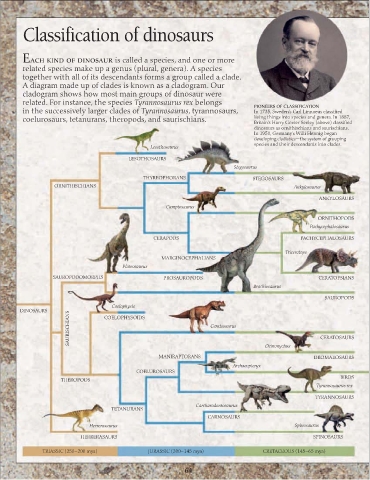
Classification of dinosaurs


        EȢȤȩ ȬȪȯȥ Ȱȧ ȥȪȯȰȴȢȶȳ is called a species, and one or more
        related species make up a genus (plural, genera). A species
        together with all of its descendants forms a group called a clade.
        A diagram made up of clades is known as a cladogram. Our
        cladogram shows how most main groups of dinosaur were
        related. For instance, the species Tyrannosaurus rex belongs
                                                                                     PIONEERS OF CLASSIFICATION
        in the successively larger clades of Tyrannosaurus, tyrannosaurs,            In 1735, Sweden’s Carl Linnaeus classified
         coelurosaurs, tetanurans, theropods, and saurischians.                      living things into species and genera. In 1887,
                                                                                     Britain’s Harry Govier Seeley (above) classified
                                                                                     dinosaurs as ornithischians and saurischians.
                                                                                     In 1950, Germany’s Willi Hennig began
                                                                                     developing cladistics—the system of grouping
                                                                                     species and their descendants into clades.
                                                   Lesothosaurus
                                            LESOTHOSAURS
                                                                              Stegosaurus
                                                THYREOPHORANS                        STEGOSAURS
                   ORNITHISCHIANS                                                                 Ankylosaurus
                                                                                                           ANKYLOSAURS
                                                        Camptosaurus

                                                                                                          ORNITHOPODS
                                                                                                        Pachycephalosaurus

                                                    CERAPODS                                        PACHYCEPHALOSAURS

                                                                                               Triceratops
                                                      MARGINOCEPHALIANS
                                          Plateosaurus

                   SAUROPODOMORPHS                     PROSAUROPODS                                       CERATOPSIANS
                                                                                     Brachiosaurus
                                                                                                            SAUROPODS
                                      Coelophysis
        DINOSAURS                   COELOPHYSOIDS
                        SAURISCHIANS                                   Ceratosaurus                        CERATOSAURS


                                                      MANIRAPTORANS                      Deinonychus     DROMAEOSAURS
                                                                              Archaeopteryx
                                              COELUROSAURS
                                                                                                                  BIRDS
                     THEROPODS
                                                                                                          Tyrannosaurus rex

                                                                                                         TYRANNOSAURS
                                                                  Carcharodontosaurus
                                      TETANURANS
                                                                      CARNOSAURS
                               Herrerasaurus                                                       Spinosaurus

                            HERRERASAURS                                                                 SPINOSAURS

               TRIASSIC (250–200 mya)             JURASSIC (200–145 mya)                CRETACEOUS (145–65 mya)

                                                              64

