


Page 108 - How It Works - Book Of Amazing Answers To Curious Questions, Volume 05-15
P. 108
How are exoplanets


                                                Discover how we are able to spot alien
           found? worlds now and in the future


              cientists had suspected that exoplanets   your own back garden with a few specialised   discovery of many others, but it isn’t the most
              – planets beyond our Solar System – had   pieces of astronomy kit and particularly dark   successful exoplanet hunter. That particular
          Sexisted for several hundred years, long   night skies.                    gong goes to NASA’s Kepler spacecraft, a
          before the fi rst confirmed detection was made.   It’s not surprising, however, that it’s the big   specialised alien-world hunter that

          Over the years some claimed to have   ground-based and space observatories run by   successfully passed the 1,000 confi rmed
          discovered an exoplanet, but it wasn’t until   various government agencies and   exoplanets milestone earlier this year.
          1992 that the detection of a planetary-mass   organisations around the world, that have   Of course, the total number of exoplanets
          object orbiting a type of star – known as a   made nearly 2,000 confirmed detections to   we’ve discovered so far is a drop in the ocean:

          millisecond pulsar – was confi rmed.   date. Most of these discoveries have been made   the Gaia telescope was launched in late 2013 to
            That observation took the power of the giant   by space telescopes at their vantage point 1.5   map a billion stars, or about one per cent of our
          Arecibo radio telescope in Puerto Rico and   million kilometres (932,057 miles) away from   own galaxy, and will help in the search for new

          some out-of-the-box thinking to detect –   Earth’s obscuring atmosphere. Hubble, which   worlds by finding the host stars that they orbit.
          techniques that are now standard procedure   had been in orbit for two years by the time the   However, given that there’s an estimated

          in the search for distant worlds. But it’s   first exoplanet was confirmed, has discovered   average of one planet for every star in the

          actually possible to detect exoplanets from   a handful of these and has contributed to the   Milky Way, we’ve still got a long way to go.

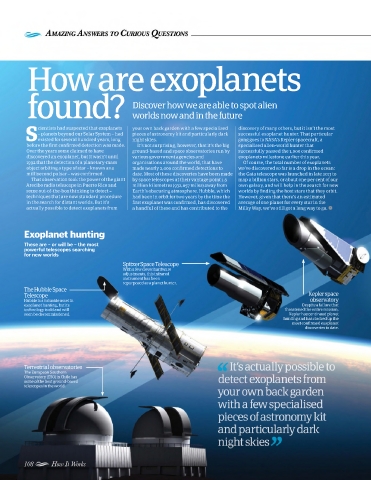
          Exoplanet hunting

          These are – or will be – the most
          powerful telescopes searching
          for new worlds
                                            Spitzer Space Telescope
                                            With a few clever hardware
                                            adjustments, this infrared
                                            instrument has been
                                            repurposed as a planet hunter.
          The Hubble Space
          Telescope                                                                                          Kepler space
          Hubble is a valuable asset in                                                                       observatory
          exoplanet hunting, but its                                                                       Despite a failure that
          technology is old and will                                                                 threatened the entire mission,
          soon be decommissioned.                                                                      Kepler has continued planet
                                                                                                     hunting and has clocked up the
                                                                                                        most confi rmed exoplanet
                                                                                                            discoveries to date.


          Terrestrial observatories
          The European Southern
          Observatory (ESO) in Chile has
          some of the best ground-based
          telescopes in the world.


          108       How It Works
          108
                   How It W

                            orks

