


Page 109 - How It Works - Book Of Amazing Answers To Curious Questions, Volume 05-15
P. 109
Space


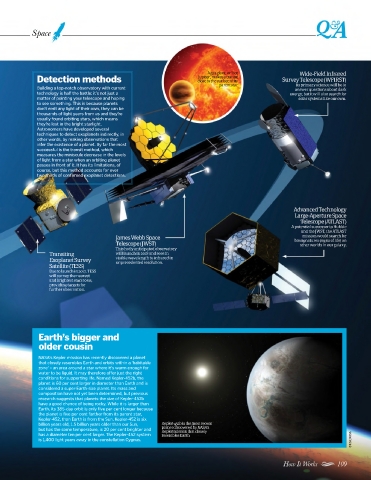
                                                                          A gas giant, or ‘hot            Wide-Field Infrared
                                                                       Jupiter’, makes a transit
              Detection methods                                       close to the surface of its   Survey Telescope (WFIRST)
                                                                              parent star                Its primary science will be to
              Building a top-notch observatory with current                                              answer questions about dark
              technology is half the battle: it’s not just a                                           energy, but it will also search for
              matter of pointing your telescope and hoping                                                solar systems like our own.
              to see something. This is because planets
              don’t emit any light of their own, they can be
              thousands of light years from us and they’re
              usually found orbiting stars, which means
              they’re lost in the bright starlight.
              Astronomers have developed several
              techniques to detect exoplanets indirectly, in
              other words, by making observations that
              infer the existence of a planet. By far the most
              successful is the transit method, which
              measures the miniscule decrease in the levels
              of light from a star when an orbiting planet
              passes in front of it. It has its limitations, of
              course, but this method accounts for over

              two thirds of confirmed exoplanet detections.


                                                                                                        Advanced Technology
                                                                                                         Large-Aperture Space
                                                                                                           Telescope (ATLAST)
                                                                                                       A potential successor to Hubble
                                                                                                           and the JWST, the ATLAST
                                                                                                           mission would search for
                                          James Webb Space                                               biosignatures (signs of life) on
                                          Telescope (JWST)                                                other worlds in our galaxy.
                                          This hotly anticipated observatory
                  Transiting              will launch in 2018 and sees in
                  Exoplanet Survey        visible wavelength to infrared in
                                          unprecedented resolution.
                  Satellite (TESS)
                  Due to launch in 2017, TESS
                  will survey the nearest
                  and brightest stars to us,
                  providing targets for
                  further observation.


               Earth’s bigger and
               older cousin

               NASA’s Kepler mission has recently discovered a planet
               that closely resembles Earth and orbits within a ‘habitable
               zone’ – an area around a star where it’s warm enough for
               water to be liquid. It may therefore offer just the right
               conditions for supporting life. Named Kepler-452b, the
               planet is 60 per cent larger in diameter than Earth and is
               considered a super-Earth-size planet. Its mass and
               composition have not yet been determined, but previous
               research suggests that planets the size of Kepler-452b
               have a good chance of being rocky. While it is larger than

               Earth, its 385-day orbit is only five per cent longer because
               the planet is five per cent farther from its parent star,

               Kepler-452, than Earth is from the Sun. Kepler-452 is six
               billion years old, 1.5 billion years older than our Sun,   Kepler-452b is the most recent
               but has the same temperature, is 20 per cent brighter and   planet discovered by NASA’s
                                                          Kepler mission that closely
               has a diameter ten per cent larger. The Kepler-452 system   resembles Earth
               is 1,400 light years away in the constellation Cygnus.                                                       © ESA; NASA

                                                                                                                        109
                                                                                                     How It Works        109
                                                                                                     How It Works

