


Page 110 - How It Works - Book Of Amazing Answers To Curious Questions, Volume 05-15
P. 110
What is space salad?


          How to grow vegetables that are out of this world                              Veggie benefits

               eliveries of fresh fruit and vegetables are   At the top of the chamber, LEDs provide light for   Growing vegetables on the ISS doesn’t just have
               rare on the ISS, so astronauts’ diets mostly   photosynthesis as well as a sense of direction to   nutritional benefits for the crew; it can also
         Dconsist of pre-packaged, non-perishable   keep the shoots growing upwards. A mixture of red   improve their psychological wellbeing too. A bit of
          foods. However, thanks to the Vegetable   and blue light is used as these are the colours of   greenery provides some relief from the metallic,
          Production System, or Veggie, being used on   light plants use most, but the resulting purple hue   lifeless environment of the space station and
          board, this is starting to change.    makes the plants appear grey and unappetising.   allows the astronauts to form a connection with a
           The Veggie plant growth chamber uses plant   Therefore, to make their crops look more   living thing. This will be particularly important for
          pillows: small bags of slow-release fertiliser and a   appealing, the astronauts can switch on additional   the deep space missions to an asteroid, and then
          clay-like soil that is also used on baseball fields.   green LEDs, which combine with the red and blue   Mars, that NASA is currently planning. For small
          These pillows are placed in a reservoir of water   to create a more natural white light. The first   crews, living in a confined space with limited
                                                                                         communication for an extended period of time,
          and have wicks inserted into them to draw the   Veggie crop was harvested in 2014 but it had to be   having a little piece of Earth to care for will help
          liquid into the soil. Plant seeds are glued onto   frozen and returned to Earth for analysis to make   them cope with the stressful and isolated
          these wicks to make sure they grow the right way   sure it was safe to eat. Once approved for   environment, as well as provide them with a
          up in the zero gravity environment – that the roots   consumption, a second crop was grown and on 10   sustainable food source. The tech used in the
          grow down into the soil and the shoots pop out the   August 2015, the Expedition 44 crew became the   Veggie system is also proving useful much closer
          top of the pillows.                   first humans to sample space-grown produce.    to home, with countries such as Dubai using it to
                                                                                         maintain a controlled plant-growing environment
                                                                                         in their hot and dry climates.


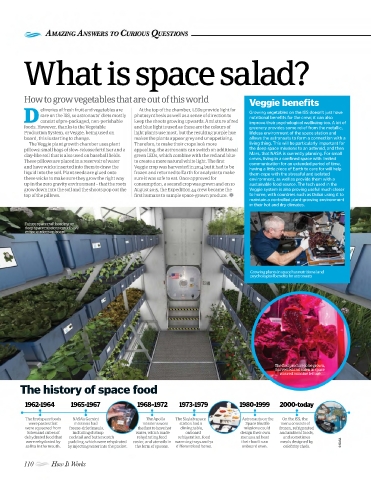
          Future spacecraft heading on
          deep space missions could have
          entire gardens on board


                                                                                         Growing plants in space has nutritional and
                                                                                         psychological benefits for astronauts


                                                                                                  The first produce to be grown,
                                                                                                  harvested and eaten in space
                                                                                                   was red romaine lettuce
        The history of space food


          1962-1964       1965-1967              1968–1972      1973-1979            1980-1999     2000-today

          The first space foods   NASA’s Gemini      The Apollo   The Skylab space     Astronauts on the   On the ISS, the
           were pastes that   missions had         missions were   station had a       Space Shuttle   menu consists of
          were squeezed from   freeze-dried meals,   the first to have hot   dining table,   missions could   frozen, refrigerated
          tubes and cubes of   including shrimp   water, which made   onboard        design their own   and ambient foods,
          dehydrated food that   cocktail and butterscotch   rehydrating food   refrigeration, food   menus and heat   and sometimes
          were rehydrated by   pudding, which were rehydrated   easier, and utensils in   warming trays and 72   their food in an   meals designed by   © NASA
          saliva in the mouth.   by injecting water into the packet.   the form of spoons.   different food items.  onboard oven.   celebrity chefs.


          110       How It Works

