


Page 159 - How It Works - Book Of Amazing Answers To Curious Questions, Volume 05-15
P. 159
History


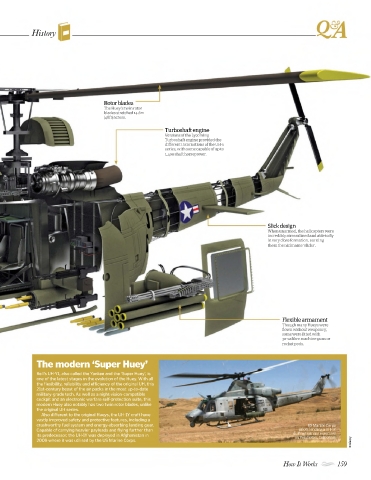
                                      Rotor blades
                                      The Huey’s twin rotor
                                      blades stretched 14.6m
                                      (48ft) across.

                                                           Turboshaft engine
                                                           Versions of the Lycoming
                                                           Turboshaft engine provided the
                                                           different incarnations of the UH-1
                                                           series, with some capable of up to
                                                           1,400 shaft horsepower.


                                                                                               Slick design
                                                                                               When unarmed, the helicopters were
                                                                                               incredibly streamlined and able to fl y
                                                                                               in very close formation, earning
                                                                                               them the nickname ‘slicks’.


                                                                                                    Flexible armament
                                                                                                    Though many Hueys were

                                                                                                    flown without weaponry,
                                                                                                    some were fi tted with
                                                                                                    30-calibre machine guns or
                                                                                                    rocket pods.

              The modern ‘Super Huey’

              Bell’s UH-Y1, also called the Yankee and the ‘Super Huey’, is
              one of the latest stages in the evolution of the Huey. With all


              the flexibility, reliability and efficiency of the original UH, this
              21st-century beast of the air packs in the most up-to-date
              military-grade tech. As well as a night-vision-compatible
              cockpit and an electronic warfare self-protection suite, this
              modern Huey also notably has two twin rotor blades, unlike
              the original UH series.
                Also different to the original Hueys, the UH-1Y craft have
              vastly improved safety and protective features, including a
              crashworthy fuel system and energy-absorbing landing gear.                                     US Marine Corps

              Capable of carrying heavier payloads and flying further than                                 pilots landing a UH-1Y
              its predecessor, the UH-1Y was deployed in Afghanistan in                                 during training exercises
                                                                                                         in Pendleton, California
              2009 where it was utilised by the US Marine Corps.                                                            © Alamy
                                                                                                     How It Works        159

