


Page 168 - How It Works - Book Of Amazing Answers To Curious Questions, Volume 05-15
P. 168
How did the Anasazi


                                  Who built these incredible cave cities
          live? in the Colorado desert?


                 hen European Americans fi rst
                 explored Chaco Canyon in New     A city on the edge
         WMexico in 1849 they must have           How the Anasazi lived                             Wooden frames
          thought they’d found a mythical lost city.                                                Anasazi homes used
          Against the canyon wall were the ruins of vast                                            ponderosa pine wood
                                                                                                    for supports.

          five-storey homes, a warren of around 800 rooms   Plaster
          like an entire town within a single set of walls.   The sandstone blocks
                                                   that made up the walls
          Among the debris were ceramic cylinders and   were often coated in a
          broken pottery, evidence of dams and irrigation   ‘plaster’ of mud.
          trenches that diverted water, and a network of
          roads nine metres (30 feet) wide.                                                         T-shaped door
           The Anasazi, whose name comes from the                                                   T-shaped doors were a
          Navajo word for ‘ancient enemies’ or ‘ancient                                             common Anasazi motif,
          ones’, built numerous similar settlements across                                          but the signifi cance of
          the Four Corners region at the intersection of                                            them is a mystery.
          what is Utah, New Mexico, Arizona and Colorado
          today, from as early as the 10th century.
           Then at some point before the end of the 13th
          century, this mysterious culture suddenly
          moved from their multi-storey ‘great houses’   Ladders
          and into caves that had been carved into the   The Anasazi moved
          seemingly inaccessible orange-brown cliff-faces   between levels with
          of southern Colorado. Just as ambitious as their   ladders; these could be
          original homes, these cliff dwellings had several   pulled up behind them
                                                   for protection.
          rooms connected by ladders and walls of
          sandstone blocks. By the 14th century these new
          dwellings were empty too; the reason for the
          Anasazi’s sudden migration may also be
          responsible for their sudden disappearance.
           Facing competition from other tribes over
          dwindling water supplies, the Anasazi may have   Kiva                                       Roof
                                                                                                      The Kiva roof
                                                   Meaning ‘world
          gathered their scattered communities into more   below’, the Kiva was                       contained a hole that
          defensible positions – literally with their backs   used as a meeting                       could be used as an
          to the wall. From there they may have left,   and ceremonial                                entrance and also
          heading further south in search of swollen rivers   room and was lined                      provided ventilation
                                                                                                      for the fire pit below.

                                                   by stone benches.
          or plentiful rainfall well away from the arid cliffs
          and canyons of the Colorado desert.
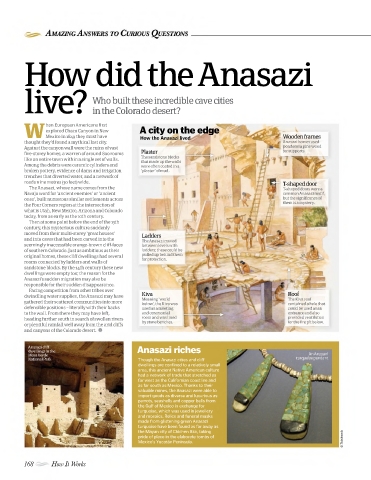
           Anasazi cliff
           dwellings in the                      Anasazi riches
           Mesa Verde                                                                                         An Anasazi
           National Park                          Though the Anasazi cities and cliff                    turquoise pendant

                                                  dwellings are confined to a relatively small
                                                  area, this ancient Native American culture
                                                  had a network of trade that stretched as
                                                  far west as the Californian coastline and
                                                  as far south as Mexico. Thanks to their
                                                  valuable mines, the Anasazi were able to
                                                  import goods as diverse and luxurious as
                                                  parrots, seashells and copper bells from
                                                  the Gulf of Mexico in exchange for
                                                  turquoise, which was used in jewellery
                                                  and mosaics. Relics and funeral masks
                                                  made from glistening green Anasazi
                                                  turquoise have been found as far away as
                                                  the Mayan city of Chichen Itza, taking
                                                  pride of place in the elaborate tombs of
                                                  Mexico’s Yucatán Peninsula.                                            © Thinkstock


          168       How It Works

