


Page 24 - How It Works - Book Of Amazing Answers To Curious Questions, Volume 05-15
P. 24
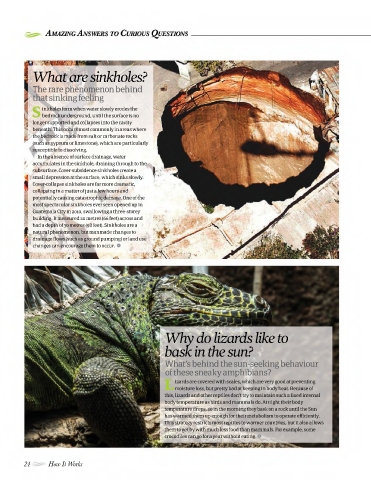
What are sinkholes?

             The rare phenomenon behind
             that sinking feeling
                inkholes form when water slowly erodes the
            S bedrock underground, until the surface is no
            longer supported and collapses into the cavity
            beneath. This occurs most commonly in areas where
            the bedrock is made from salt or carbonate rocks
            (such as gypsum or limestone), which are particularly
            susceptible to dissolving.
              In the absence of surface drainage, water
            accumulates in the sinkhole, draining through to the
            subsurface. Cover-subsidence sinkholes create a
            small depression at the surface, which sinks slowly.
            Cover-collapse sinkholes are far more dramatic,
            collapsing in a matter of just a few hours and
            potentially causing catastrophic damage. One of the
            most spectacular sinkholes ever seen opened up in
            Guatemala City in 2010, swallowing a three-storey
            building. It measured 20 metres (66 feet) across and
            had a depth of 30 metres (98 feet). Sinkholes are a
            natural phenomenon, but manmade changes to
            drainage flows (such as ground pumping) or land use
            changes can encourage them to occur.


                                                           Why do lizards like to

                                                           bask in the sun?

                                                           What’s behind the sun-seeking behaviour
                                                           of these sneaky amphibians?
                                                               izards are covered with scales, which are very good at preventing
                                                           L moisture loss, but pretty bad at keeping in body heat. Because of
                                                           this, lizards and other reptiles don’t try to maintain such a fixed internal
                                                           body temperature as birds and mammals do. At night their body
                                                           temperature drops, so in the morning they bask on a rock until the Sun
                                                           has warmed them up enough for their metabolism to operate efficiently.
                                                           This strategy restricts most reptiles to warmer countries, but it also allows
                                                           them to get by with much less food than mammals. For example, some
                                                           crocodiles can go for a year without eating.


          24       How It Works

